
|
You entered: gamma ray
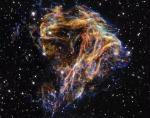 N49 s Cosmic Blast
4.07.2003
Scattered debris from a cosmic supernova explosion lights up the sky in this gorgeous composited image based on data from the Hubble Space Telescope. Cataloged as N49, these glowing filaments of shocked gas span about 30 light-years in our neighboring galaxy, the Large Magellanic Cloud.
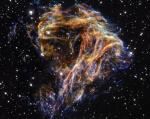 N49's Cosmic Blast
6.03.2004
Scattered debris from a cosmic supernova explosion lights up the sky in this gorgeous composited image based on data from the Hubble Space Telescope. Cataloged as N49, these glowing filaments of shocked gas span about 30 light-years in our neighboring galaxy, the Large Magellanic Cloud.
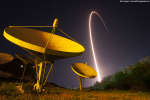 Atlas V Launches TDRS-K
1.02.2013
Beyond a fertile field of satellite communication antennas at Kennedy Space Center, an Atlas V rocket streaks into orbit in this long exposure photograph. In the thoughtfully composed image recorded on the evening...
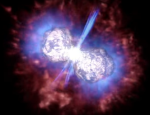 Eta Car: 3D Model of the Most Dangerous Star Known
9.02.2022
What's the most dangerous star near earth? Many believe it's Eta Carinae, a binary star system about 100 times the mass of the Sun, just 10,000 light years from earth.
 The Colorful Clouds of Rho Ophiuchi
2.06.2004
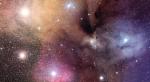
The many spectacular colors of the Rho Ophiuchi (oh'-fee-yu-kee) clouds highlight the many processes that occur there. The blue regions shine primarily by reflected light. Blue light from the star Rho Ophiuchi and nearby stars reflects more efficiently off this portion of the nebula than red light.
 NGC 4993: The Galactic Home of an Historic Explosion
23.10.2017
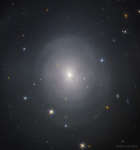
That reddish dot -- it wasn't there before. It's the dot to the upper left of galaxy NGC 4993's center, do you see it? When scanning the large field of possible locations...
 The Colorful Clouds of Rho Ophiuchi
14.10.2020
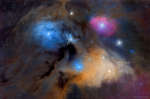
The many spectacular colors of the Rho Ophiuchi (oh'-fee-yu-kee) clouds highlight the many processes that occur there. The blue regions shine primarily by reflected light. Blue light from the Rho Ophiuchi star system and nearby stars reflects more efficiently off this portion of the nebula than red light.
 APOD: 2025 February 3 Б Wolf Rayet Star 124: Stellar Wind Machine
3.02.2025
Some stars explode in slow motion. Rare, massive Wolf-Rayet stars are so tumultuous and hot that they are slowly disintegrating right before our telescopes. Glowing gas globs each typically over 30 times more massive than the Earth are being expelled by violent stellar winds.
 The Colorful Clouds of Rho Ophiuchi
9.07.2005
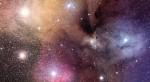
The many spectacular colors of the Rho Ophiuchi (oh'-fee-yu-kee) clouds highlight the many processes that occur there. The blue regions shine primarily by reflected light. Blue light from the star Rho Ophiuchi and nearby stars reflects more efficiently off this portion of the nebula than red light.
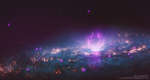 X Ray Superbubbles in Galaxy NGC 3079
5.03.2019
What created these huge galactic superbubbles? Two of these unusual bubbles, each spanning thousands of light-years, were recently discovered near the center of spiral galaxy NGC 3079. The superbubbles, shown in purple on the image right, are so hot they emit X-rays detected by NASA's Earth-orbiting Chandra X-Ray Observatory.
|
January February March April May June July August September October |
|||||||||||||||||||||||||||||||||||||||||||||||||