
|
You entered: universe
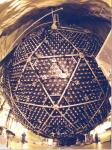 The Sudbury Neutrino Detector
23.06.1999
Two thousand meters below the ground, a giant sphere has begun to detect nearly invisible particles. These particles, neutrinos, are extremely abundant in the universe but usually go right through just about everything.
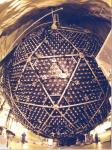 The Sudbury Neutrino Detector
25.02.2001
Two thousand meters below the ground, a giant sphere has begun to detect nearly invisible particles. These particles, neutrinos, are extremely abundant in the universe but usually go right through just about everything. By stocking this 12-meter sphere with an unusual type of hea
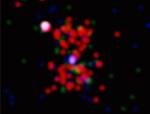 3C294: Distant X Ray Galaxy Cluster
22.02.2001
Large clusters of galaxies are the most massive objects in the universe. Astronomers now realize that a hallmark of these cosmic behemoths are gas clouds with temperatures of tens of millions of degrees that pervade the clusters and radiate strongly in x-rays.
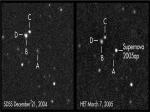 SN 2005ap: The Brightest Supernova Yet Found
16.10.2007
What could cause a bang this big? This supernova explosion was so inherently bright that it could be seen nearby 5 billion light years away (a redshift of 0.28) even with a small telescope.
 On the Origin of Gold
5.04.2001
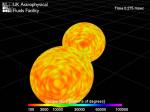
Where did the gold in your jewelry originate? No one is completely sure. The relative average abundance in our Solar System appears higher than can be made in the early universe, in stars, and even in typical supernova explosions. Some astronomers now
 APOD: 2026 August 10 Б Three Galaxy Pairs
10.08.2026
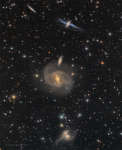
Each of these pairs of galaxies is different. The two galaxies at the top are likely not interacting, at least presently. However, the top galaxy with the blue stripe, NGC 4650A, is a polar ring galaxy and may be the result of a past galaxy collision.
 The Sloan Digital Sky Survey Telescope
17.06.1998
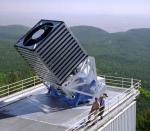
The Sloan Digital Sky Survey (SDSS) will soon begin. Pictured above is the 2.5-meter telescope poised to create the most ambitious sky map in the history of astronomy. SDSS will catalog one quarter of the sky down past 23rd magnitude ( R), obtaining redshifts for galaxies and quasars brighter than magnitude 19.
 Spiral Galaxy M90
16.03.1996
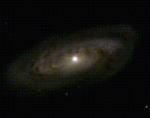
Spiral galaxy M90 is near the center of the Virgo Cluster of Galaxies - the closest cluster of galaxies to the our own Milky Way Galaxy. Also dubbed NGC 4569, this galaxy has a very compact and bright nucleus.
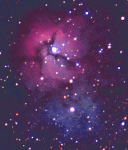 M20: The Trifid Nebula
23.07.1995
The vivid blue and violet colors present in the Trifid Nebula result from the abundance of young stars there. The light from young massive stars is quite blue and has the ability to remove electrons from surrounding gas. When these electrons re-combine with the gas, radiation rich in blue and violet light is emitted.
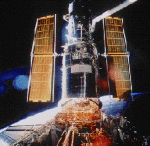 The Orbiting Hubble Space Telescope
10.08.1995
The Hubble Space Telescope (HST) is the largest orbiting public optical telescope in history. Its 2.4 meter diameter reflecting mirror and its perch above Earth's atmosphere allow it to create exceptionally sharp images.
|
January February March April May June July August September October |
|||||||||||||||||||||||||||||||||||||||||||||||||