
|
You entered: time
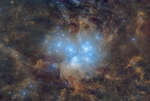 APOD: 2026 February 23 Б Pleiades: The Seven Sisters Star Cluster
23.02.2026
Have you ever seen the Pleiades star cluster? Even if you have, you probably have never seen it as large and clear as this. Perhaps the most famous star cluster on the sky, the bright stars of the Pleiades can be seen with the unaided eye even from the depths of a light-polluted city.
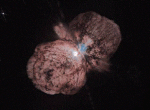 Doomed Star Eta Carinae
11.06.1996
Eta Carinae may be about to explode. But no one knows when - it may be next year, it may be one million years from now. Eta Carinae's mass - about 100 times greater than our Sun - make it an excellent candidate for a full blown supernova.
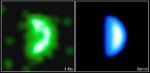 Venusian Half Shell
11.12.2001
Venus, second planet from the Sun, appears above imaged for the first time ever in x-rays (left) by the orbiting Chandra Observatory. Chandra's smoothed, false-color, x-ray view is compared to an optical image (right) from a small earthbound telescope.
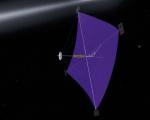 Solar Sail
21.08.2004
Could solar sailing become a future Olympic sport? Nearly 400 years ago astronomer Johannes Kepler observed comet tails blown by a solar breeze and suggested that vessels might likewise navigate through space using appropriately fashioned sails.
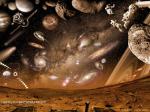 APOD Turns Eleven
16.06.2006
The first APOD appeared eleven years ago today, on 1995 June 16. Although garnering only 14 page views on that day, we are proud to estimate that APOD has now served over 400 million space-related images over the last eleven years.
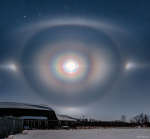 Moon Corona, Halo, and Arcs over Manitoba
24.02.2020
Yes, but could you get to work on time if the Moon looked like this? As the photographer was preparing to drive to work, refraction, reflection, and even diffraction of moonlight from millions of falling ice crystals turned the familiar icon of our Moon into a menagerie of other-worldly halos and arcs.
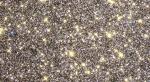 The Center of Globular Cluster Omega Centauri
10.10.2001
What is left over after stars collide? To help answer this question, astronomers have been studying the center of the most massive ball of stars in our Milky Way Galaxy. In the center of globular cluster Omega Centauri, stars are packed in 10,000 times more densely than near our Sun.
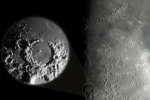 Hesiodus Sunrise Ray
27.03.2010
Stark shadows of mountains and crater walls stand out along the lunar terminator, or shadow line between night and day, in this telescopic image. Of course, if viewed from the lunar surface near the terminator line, the Sun would be rising and still close to the lunar horizon.
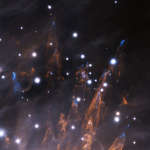 The Orion Bullets
10.01.2013
Cosmic bullets pierce the outskirts of the Orion Nebula some 1500 light-years distant in this sharp infrared close-up. Blasted out by energetic massive star formation the bullets, relatively dense, hot gas clouds about ten times the size of Pluto's orbit, are blue in the false color image.
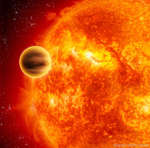 NGST 10b: Discovery of a Doomed Planet
26.02.2020
This hot jupiter is doomed. Hot jupiters are giant planets like Jupiter that orbit much closer to their parent stars than Mercury does to our Sun. But some hot jupiters are more extreme than others. NGTS-10b, illustrated generically, is the closest and fastest-orbiting giant planet yet discovered, circling its home star in only 18 hours.
|
January February March April May June July August |
||||||||||||||||||||||||||||||||||||||||||||||||||||||||