
|
You entered: dark
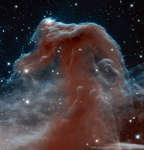 The Horsehead Nebula in Infrared from Hubble
12.04.2020
While drifting through the cosmos, a magnificent interstellar dust cloud became sculpted by stellar winds and radiation to assume a recognizable shape. Fittingly named the Horsehead Nebula, it is embedded in the vast and complex Orion Nebula (M42).
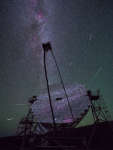 Perseids and MAGIC
11.08.2022
On August 11, 2021 a multi-mirror, 17 meter-diameter MAGIC telescope reflected this starry night sky from the Roque de los Muchachos European Northern Observatory on the Canary Island of La Palma. MAGIC stands for Major Atmospheric Gamma Imaging Cherenkov.
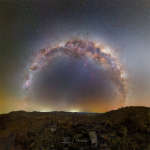 Stargate Milky Way
17.08.2022
There is a huge gate of stars in the sky, and you pass through it twice a day. The stargate is actually our Milky Way Galaxy, and it is the spin of the Earth that appears to propel you through it.
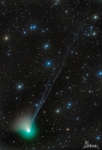 APOD: 2023 January 9 Б Tails of Comet ZTF
9.01.2023
Comet ZTF may become visible to the unaided eye. Discovered early last year, this massive snowball has been brightening as it approaches the Sun and the Earth. C/2022 E3 (ZTF) will be closest...
 APOD: 2025 September 9 Б Up from the Earth: Gigantic Jet Lightning
9.09.2025
What's that rising up from the Earth? When circling the Earth on the International Space Station early in July, astronaut Nicole Ayers saw an unusual type of lightning rising up from the Earth: a gigantic jet. The powerful jet appears near the center of the featured image in red, white, and blue.
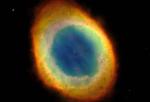 M57: The Ring Nebula
22.03.2003
Except for the rings of Saturn, the Ring Nebula (M57) is probably the most famous celestial band. This planetary nebula's simple, graceful appearance is thought to be due to perspective -- our view from planet Earth looking straight into what is actually a barrel-shaped cloud of gas shrugged off by a dying central star.
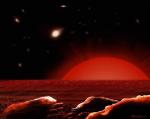 Stars Without Galaxies
3.02.1997
Galaxies are made up of stars, but are all stars found within galaxies? Apparently not. Using the Hubble Space Telescope, researchers exploring the Virgo Cluster of galaxies have now found about 600 red giant stars adrift in intergalactic space.
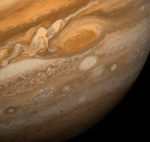 The Clouds of Jupiter
20.09.1997
What makes the colors in Jupiter's clouds? With a mean temperature of 120 degrees Kelvin (-153 degrees Celsius) and a composition dominated by hydrogen (about 90%), and helium (about 10%) with a smattering...
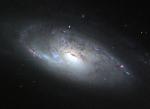 M106: A Spiral Galaxy with a Strange Core
15.02.2000
What's happening at the center of spiral galaxy M106? A swirling disk of stars and gas, M106's appearance is dominated by two bright spiral arms and dark dust lanes near the nucleus. Bright newly formed stars near their outer tips distinguish the spiral arms in the above photograph.
 Jupiter s Clouds from New Horizons
15.10.2007
The New Horizons spacecraft took some stunning images of Jupiter earlier this year while on the way out to Pluto. Famous for its Great Red Spot, Jupiter is also known for its regular, equatorial cloud bands, visible through even modest sized telescopes.
|
January February March April May June July August September |
|||||||||||||||||||||||||||||||||||||||||||||||||