
|
You entered: dust
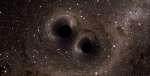 Two Black Holes Merge
12.02.2016
Just press play to watch two black holes merge. Inspired by the first direct detection of gravitational waves by LIGO, this simulation video plays in slow motion but would take about one third of a second if run in real time.
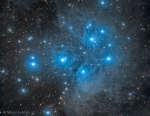 M45: The Pleiades Star Cluster
1.09.2019
Have you ever seen the Pleiades star cluster? Even if you have, you probably have never seen it as dusty as this. Perhaps the most famous star cluster on the sky, the bright stars of the Pleiades can be seen without binoculars from even the depths of a light-polluted city.
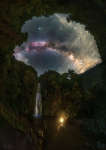 A Waterfall and the Milky Way
1.11.2021
The dream was to capture both the waterfall and the Milky Way together. Difficulties included finding a good camera location, artificially illuminating the waterfall and the surrounding valley effectively, capturing the entire scene with...
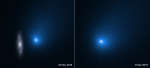 Interstellar Comet 2I Borisov
5.03.2022
From somewhere else in the Milky Way galaxy, Comet 2I/Borisov was just visiting the Solar System. Discovered by amateur astronomer Gennady Borisov on August 30, 2019, the first known interstellar comet is seen in these two Hubble Space Telescope images from November and December 2019.
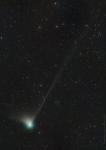 Comet 2022 E3 ZTF
24.12.2022
Comet C/2022 E3 (ZTF) was discovered by astronomers using the wide-field survey camera at the Zwicky Transient Facility this year in early March. Since then the new long-period comet has brightened substantially and is now sweeping across the northern constellation Corona Borealis in predawn skies.
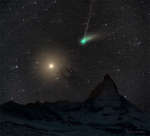 APOD: 2023 February 13 Б Comet ZTF and Mars
13.02.2023
No, Comet ZTF is not going to hit Mars. Nicknamed the Green Comet for its bright green coma, C/2022 E3 (ZTF) did, however, pass almost in front of the much-more distant planet a few days ago, very near in time to when the featured picture was taken.
 APOD: 2023 July 17 Б Shells and Arcs around Star CW Leonis
17.07.2023
What's happening around this star? No one is sure. CW Leonis is the closest carbon star, a star that appears orange because of atmospheric carbon dispersed from interior nuclear fusion. But CW Leonis also appears engulfed in a gaseous carbon-rich nebula.
 APOD: 2025 April 20 Б The Orion Nebula in Visible and Infrared
20.04.2025
The Great Nebula in Orion is a colorful place. Visible to the unaided eye, it appears as a small fuzzy patch in the constellation of Orion. Long exposure, multi-wavelength images like this, however, show the Orion Nebula to be a busy neighborhood of young stars, hot gas, and dark dust.
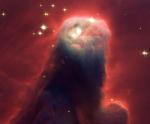 Cone Nebula Close Up
3.05.2002
Cones, pillars, and majestic flowing shapes abound in stellar nurseries where natal clouds of gas and dust are buffeted by energetic winds from newborn stars. A well-known example, the Cone Nebula within the bright galactic star-forming region NGC 2264, was captured in this close-up view from the Hubble Space Telescope's newest camera.
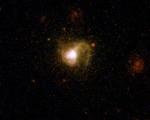 POX 186: Not So Long Ago
28.02.2004
Not so long ago and not so far, far away, a galaxy was born. Seen in this Hubble Space Telescope image, the island universe of stars, gas, and dust cataloged as POX 186 is a mere 68 million light-years distant toward an uncrowded region in the constellation Virgo.
|
January February March April May June July August September October |
|||||||||||||||||||||||||||||||||||||||||||||||||