
|
You entered: color
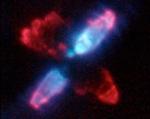 Shells in the Egg Nebula
20.05.1997
The Egg Nebula is taking a beating. Like a baby chick pecking its way out of an egg, the star in the center of the Egg Nebula is casting away shells of gas and dust as it slowly transforms itself into a white dwarf star.
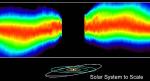 Closer To Beta Pic
22.01.1998
What did our Solar System look like as the planets were forming? Since the 1980s, astronomers have been pointing toward Beta Pictoris, a young, sun-like star a mere 50 light-years distant, as a likely example. Beta Pic is surrounded by a disk of dust which we view nearly edge-on.
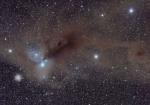 Stars and Dust in Corona Australis
15.07.2004
A cosmic dust cloud sprawls across a rich field of stars in this gorgeous wide field telescopic vista looking toward Corona Australis, the Southern Crown. Probably less than 500 light-years away and effectively blocking...
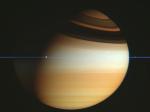 Cassini Spacecraft Crosses Saturns Ring Plane
4.05.2005
If this is Saturn, where are the rings? When Saturn's "appendages" disappeared in 1612, Galileo did not understand why. Later that century, it became understood that Saturn's unusual protrusions were rings and that when the Earth crosses the ring plane, the edge-on rings will appear to disappear.
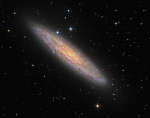 NGC 253: Dusty Island Universe
3.11.2016
Shiny NGC 253 is one of the brightest spiral galaxies visible, and also one of the dustiest. Some call it the Silver Dollar Galaxy for its appearance in small telescopes, or just the Sculptor Galaxy for its location within the boundaries of the southern constellation Sculptor.
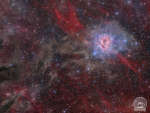 Cocoon Nebula Deep Field
19.09.2018
Inside the Cocoon Nebula is a newly developing cluster of stars. The cosmic Cocoon on the upper right also punctuates a long trail of obscuring interstellar dust clouds to its left. Cataloged...
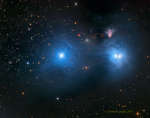 Stars and Dust in Corona Australis
20.09.2018
Cosmic dust clouds and young, energetic stars inhabit this telescopic vista, less than 500 light-years away toward the northern boundary of Corona Australis, the Southern Crown. The dust clouds effectively block light from more distant background stars in the Milky Way.
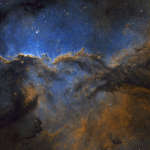 NGC 6188: The Dragons of Ara
7.11.2018
Dark shapes with bright edges winging their way through dusty NGC 6188 are tens of light-years long. The emission nebula is found near the edge of an otherwise dark large molecular cloud in the southern constellation Ara, about 4,000 light-years away.
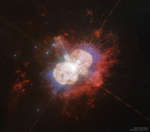 Doomed Star Eta Carinae
20.02.2019
Eta Carinae may be about to explode. But no one knows when - it may be next year, it may be one million years from now. Eta Carinae's mass - about 100 times greater than our Sun - makes it an excellent candidate for a full blown supernova.
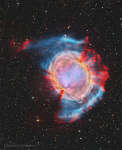 APOD: 2026 June 22 Б M27: The Dumbbell Nebula
22.06.2026
Is this what will become of our Sun? Quite possibly. The first hint of our Sun's future was discovered inadvertently in 1764. At that time, Charles Messier was compiling a list of diffuse objects not to be confused with comets.
|
January February March April May June July August September October |
|||||||||||||||||||||||||||||||||||||||||||||||||