
|
You entered: sky
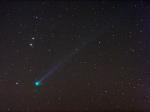 Unexpected Comet Pojmanski Now Visible
6.03.2006
Have you ever seen a comet? Comets bright enough to be visible to the unaided eye appear only every few years. Right now, however, a new comet has brightened unexpectedly and is visible as a faint streak to the unaided northern observer in the eastern morning sky just before sunrise. Binoculars may help.
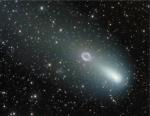 Comet Meets Ring Nebula: Part II
12.05.2006
Moving rapidly through planet Earth's night sky, Fragment C of crumbling comet 73P/Schwassmann-Wachmann 3 passed almost directly in front of M57 - the Ring Nebula, and faint spiral galaxy IC 1296 on May 8.
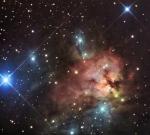 NGC 1579: Trifid of the North
25.05.2006
Colorful NGC 1579 resembles the better known Trifid Nebula, but lies much farther north in planet Earth's sky, in the heroic constellation Perseus. About 2,100 light-years away and 3 light-years across, NGC 1579 is a captivating study in color.
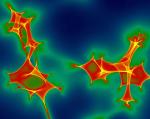 A Network of Microlensing Caustics
24.08.1999
A virtual sky map like this would be of interest to astronomers studying gravitational microlensing. In microlensing, the gravity of stars near the line of sight can act to magnify the light of background objects such as distant stars, or quasars. Nowhere is this magnification greater than near a gravitational lensing caustic.
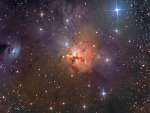 NGC 1579: Trifid of the North
30.01.2009
Colorful NGC 1579 resembles the better known Trifid Nebula, but lies much farther north in planet Earth's sky, in the heroic constellation Perseus. About 2,100 light-years away and 3 light-years across...
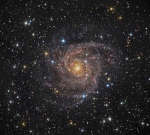 Hidden Galaxy IC 342
22.12.2010
Similar in size to other large, bright spiral galaxies, IC 342 is a mere 7 million light-years distant in the long-necked, northern constellation Camelopardalis. A sprawling island universe, IC 342 would otherwise...
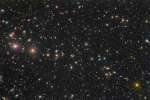 The Perseus Cluster of Galaxies
12.07.2011
Here is one of the largest objects that anyone will ever see on the sky. Each of these fuzzy blobs is a galaxy, together making up the Perseus Cluster, one of the closest clusters of galaxies. The cluster is seen through a foreground of faint stars in our own Milky Way Galaxy.
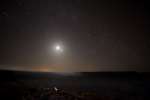 The Grand Canyon in Moonlight
30.03.2012
In this alluring night skyscape recorded on March 26, a young Moon stands over the distant western horizon in conjunction with brilliant planet Venus. In the foreground, the Colorado River glistens in moonlight as it winds through the Grand Canyon, seen from the canyon's southern rim at Lipan Point.
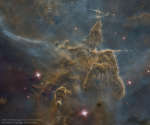 Mystic Mountain Dust Pillars
15.04.2015
It's stars versus dust in the Carina Nebula and the stars are winning. More precisely, the energetic light and winds from massive newly formed stars are evaporating and dispersing the dusty stellar nurseries in which they formed.
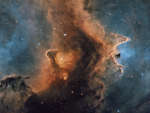 IC 1871: Inside the Soul Nebula
29.10.2015
This cosmic close-up looks deep inside the Soul Nebula. The dark and brooding dust clouds outlined by bright ridges of glowing gas are cataloged as IC 1871. About 25 light-years across, the telescopic field of view spans only a small part of the much larger Heart and Soul nebulae.
|
January February March April May June July August September October |
|||||||||||||||||||||||||||||||||||||||||||||||||