
|
You entered: Earth's moon
 Moon Pi and Mountain Shadow
14.03.2024
What phase of the Moon is 3.14 radians from the Sun? The Full Moon, of course. Even though the Moon might look full for several days, the Moon is truly at its full phase when it is Pi radians (aka 180 degrees) from the Sun in ecliptic longitude.
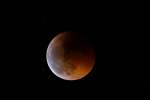 Eclipsed Moonlight
21.06.2011
A celestial prelude to today's solstice, the June 15 total lunar eclipse was one of the longest in recent years. It was also one of the darkest, but not completely dark. Even during...
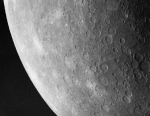 Southwest Mercury
13.09.1996
The planet Mercury resembles a moon. Mercury's old surface is heavily cratered like many moons. Mercury is larger than most moons but smaller than Jupiter's moon Ganymede and Saturn's moon Titan. Mercury is much denser and more massive than any moon, though, because it is made mostly of iron.
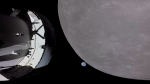 Earthset from Orion
24.01.2026
Eight billion people are about to disappear in this snapshot from space taken on 2022 November 21. On the sixth day of the Artemis I mission, their home world is setting behind the Moon's bright edge as viewed by an external camera on the outbound Orion spacecraft.
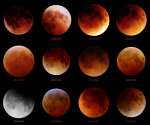 Twelve Lunar Eclipses
29.02.2008
Welcome to the extra day in the Gregorian Calendar's leap year 2008! To celebrate, consider this grid of lunar eclipse pictures - starting in leap year 1996 and ending with February's eclipse - with the date in numerical year/month/day format beneath each image.
 Southwest Mercury
16.02.2003
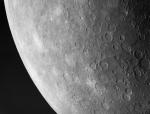
The planet Mercury resembles a moon. Mercury's old surface is heavily cratered like many moons. Mercury is larger than most moons but smaller than Jupiter's moon Ganymede and Saturn's moon Titan. Mercury is much denser and more massive than any moon, though, because it is made mostly of iron.
 Southwest Mercury
13.02.2000
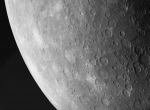
The planet Mercury resembles a moon. Mercury's old surface is heavily cratered like many moons. Mercury is larger than most moons but smaller than Jupiter's moon Ganymede and Saturn's moon Titan. Mercury is much denser and more massive than any moon, though, because it is made mostly of iron.
 The Day After Mars
31.10.2014
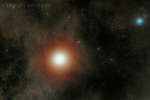
October 31, 1938 was the day after Martians encountered planet Earth, and everything was calm. Reports of the invasion were revealed to be part of a Halloween radio drama, the now famous broadcast based on H.G. Wells' scifi novel War of the Worlds.
 The Day After Mars
1.11.2019
October 31, 1938 was the day after Martians encountered planet Earth, and everything was calm. Reports of the invasion were revealed to be part of a Halloween radio drama, the now famous broadcast based on H.G. Wells' scifi novel War of the Worlds.
 Lunation
29.08.2004
Our Moon's appearance changes nightly. This time-lapse sequence shows what our Moon looks like during a lunation, a complete lunar cycle. As the Moon orbits the Earth, the half illuminated by the Sun first becomes increasingly visible, then decreasingly visible. The Moon always keeps the same face toward the Earth.
|
January February March April May June July August September |
|||||||||||||||||||||||||||||||||||||||||||||||||