
|
You entered: deep field
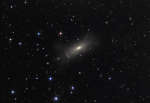 Shell Galaxy NGC 7600
23.12.2011
Similar in size to the Milky Way, elliptical galaxy NGC 7600 is about 150 thousand light-years distant. In this deep image, spanning about 1/2 degree on the sky toward the constellation Aquarius, NGC 7600 sports a remarkable outer halo of nested shells and broad circumgalactic structures.
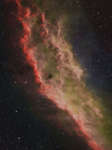 NGC 1499: The California Nebula
2.03.2011
What's California doing in space? Drifting through the Orion Arm of the spiral Milky Way Galaxy, this cosmic cloud by chance echoes the outline of California on the west coast of the United States.
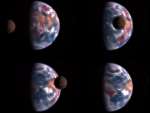 31 Million Miles from Planet Earth
3.09.2008
On July 4th, 2005, the Deep Impact spacecraft directed a probe to impact the nucleus of Comet Tempel 1. Still cruising through the solar system, earlier this year the robotic spacecraft looked back to record a series of images of its home world 31 million miles (50 million kilometers) away.
 The Long Tails of Comet NEOWISE
16.07.2020
This Comet NEOWISE (C/2020 F3) now sweeps through our fair planet's northern skies. Its long tails stretch across this deep skyview from Suchy Vrch, Czech Republic. Recorded on the night of July 13/14...
 APOD: 2024 January 29 Б The Pleiades: Seven Dusty Sisters
29.01.2024
The well-known Pleiades star cluster is slowly destroying part of a passing cloud of gas and dust. The Pleiades is the brightest open cluster of stars on Earth's sky and can be seen from almost any northerly location with the unaided eye.
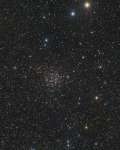 NGC 7789: Caroline s Rose
26.10.2013
Found among the rich starfields of the Milky Way toward the constellation Cassiopeia, star cluster NGC 7789 lies about 8,000 light-years away. A late 18th century deep sky discovery of astronomer Caroline Lucretia Herschel, the cluster is also known as Caroline's Rose.
 Three Galaxies in Draco
1.07.2023
This tantalizing trio of galaxies sometimes called the Draco Group, is located in the northern constellation of (you guessed it) Draco, the Dragon. From left to right are face-on spiral NGC 5985, elliptical galaxy...
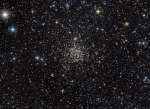 NGC 7789: Caroline's Rose
15.11.2017
Found among the rich starfields of the Milky Way, star cluster NGC 7789 lies about 8,000 light-years away toward the constellation Cassiopeia. A late 18th century deep sky discovery of astronomer Caroline Lucretia Herschel, the cluster is also known as Caroline's Rose.
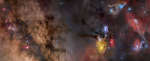 From the Galactic Plane through Antares
2.07.2018
Behold one of the most photogenic regions of the night sky, captured impressively. Featured, the band of our Milky Way Galaxy runs diagonally along the far left, while the colorful Rho Ophiuchus region including...
 APOD: 2025 April 14 Б The Galactic Center in Radio from MeerKAT
14.04.2025
What's happening at the center of our galaxy? It's hard to tell with optical telescopes since visible light is blocked by intervening interstellar dust. In other bands of light, though, such as radio, the galactic center can be imaged and shows itself to be quite an interesting and active place.
|
January February March April May June July August September |
|||||||||||||||||||||||||||||||||||||||||||||||||