
|
You entered: face
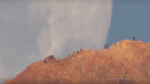 Moon Setting Behind Teide Volcano
22.03.2020
These people are not in danger. What is coming down from the left is just the Moon, far in the distance. Luna appears so large here because she is being photographed through a telescopic lens.
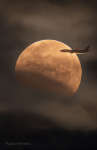 APOD: 2026 September 1 Б A Plane Lunar Eclipse
1.09.2026
Did you need to be on the right side of this airplane to see this eclipse? No. Lunar eclipses are routinely seen from the half of the Earth facing the Moon when the eclipse occurs, making them some of the most commonly witnessed astronomical events.
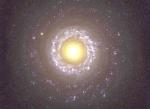 Spiral Galaxy NGC 7742
1.07.2001
This might resemble a fried egg you've had for breakfast, but it's actually much larger. In fact, ringed by blue-tinted star forming regions and faintly visible spiral arms, the yolk-yellow center of this face-on spiral galaxy, NGC 7742, is about 3,000 light-years across.
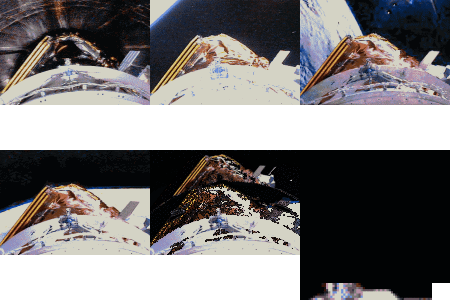 Swift RocketCam
24.12.2004
A forward-facing RocketCam (TM) mounted inside the payload fairing of a Delta II rocket captured these dramatic video frames on November 20th -- as the Swift satellite observatory journeyed to an orbit 600 kilometers above planet Earth. Some frames were interpolated to correct for transmission problems.
 LADEE Launch Streak
11.09.2013
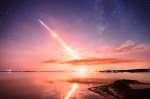
On September 6, a starry night and the Milky Way witnessed the launch of a Minotaur V rocket from NASA's Wallops Flight Facility on Wallops Island, Virginia. So did a large part of the eastern United States, as the spectacular night launch was easily visible even from light polluted urban areas.
 Jupiter s Triple Shadow Transit
2.11.2013
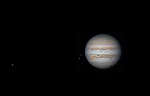
This webcam and telescope image of banded gas giant Jupiter shows the transit of three shadows cast by Jupiter's moons in progress, captured in Belgian skies on October 12 at 0528 UT. Such a three shadow transit is a relatively rare event, even for a large planet with many moons.
 Moons Near Jupiter
23.05.2019
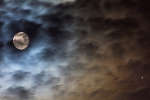
On May 20, a nearly Full Moon and Jupiter shared this telephoto field of view. Captured when a passing cloud bank dimmed the moonlight, the single exposure reveals the familiar face of our fair planet's own large natural satellite, along with bright Jupiter (lower right) and some of its Galilean moons.
 Stereo Helene
15.06.2019
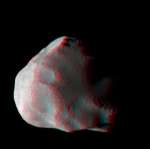
Get out your red/blue glasses and float next to Helene, small, icy moon of Saturn. Appropriately named, Helene is one of four known Trojan moons, so called because it orbits at a Lagrange point. A Lagrange point is a gravitationally stable position near two massive bodies, in this case Saturn and larger moon Dione.
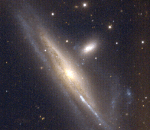 Interacting Galaxies
10.07.1998
This dramatic image of an interacting pair of galaxies was made using the 1.5 meter telescope at the Cerro Tololo Inter-American Observatory near La Serena, Chile. NGC 1531 is the background galaxy with a bright core just above center and NGC 1532 is the foreground spiral galaxy laced with dust lanes.
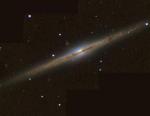 Edge On Spiral Galaxy NGC 891
20.12.1998
Is our Galaxy this thin? We believe so. The Milky Way, like NGC 891 pictured above, has the width of a typical spiral galaxy. Spirals have most of their bright stars, gas, and obscuring dust in a thin disk.
|
January February March April May June July August September |
|||||||||||||||||||||||||||||||||||||||||||||||||