
|
You entered: full moon
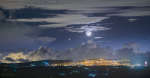 Earthshine Moon over Sicily
18.10.2021
Why can we see the entire face of this Moon? When the Moon is in a crescent phase, only part of it appears directly illuminated by the Sun. The answer is earthshine, also known as earthlight and the da Vinci glow.
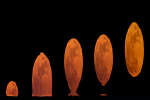 An Etruscan Vase Moon Rising
23.02.2009
What's happened to the Moon? Nothing, although from some locations, February's full moon, which occurred about two weeks ago, appeared strangely distorted as it rose. Visible in particular was a curiously inverted...
 Jupiter by Moonlight
3.11.2023
That bright beacon you've seen rising in the east just after sunset is Jupiter. Climbing high in midnight skies, our Solar System's ruling gas giant was at its 2023 opposition, opposite the Sun in planet Earth's sky, on November 2.
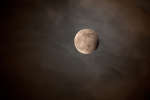 Blue Moon Eclipse
2.01.2010
The International Year of Astronomy 2009 ended with a Blue Moon and a partial lunar eclipse, as the second Full Moon of December grazed the Earth's shadow on December 31st. The New Year...
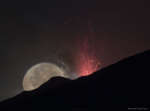 Moon behind Lava Fountain
4.09.2018
What's happened to the Moon? Nothing, but something has happened to the image of the Moon. The heat from a volcanic lava fountain in the foreground has warmed and made turbulent the air nearby, causing passing light to refract differently than usual.
 Halloween s Moon
5.11.2009
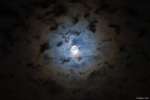
Illuminating the landscape all through the night of November 2nd, this week's bright Full Moon was known in the northern hemisphere as a Hunter's Moon. But this dramatic view of the shining lunar orb, from Sobreda, Portugal, was captured just a few nights earlier, on Halloween.
 Great Conjunction: Saturn and Jupiter Converge
15.12.2020
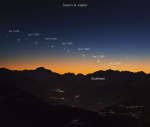
It's happening. Saturn and Jupiter are moving closer and will soon appear in almost exactly the same direction. Coincidentally, on the night of the December solstice -- the longest night of the year in the north and the longest day in the south -- the long-awaited Great Conjunction will occur.
 Moon Over Andromeda
28.12.2006
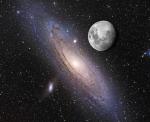
The Great Spiral Galaxy in Andromeda (aka M31), a mere 2.5 million light-years distant, is the closest large spiral to our own Milky Way. Andromeda is visible to the unaided eye as a small...
 Moon Over Andromeda
1.08.2013
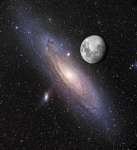
The Great Spiral Galaxy in Andromeda (aka M31), a mere 2.5 million light-years distant, is the closest large spiral to our own Milky Way. Andromeda is visible to the unaided eye as a small...
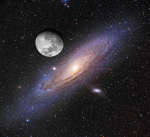 Moon over Andromeda
25.09.2020
The Great Spiral Galaxy in Andromeda (also known as M31), a mere 2.5 million light-years distant, is the closest large spiral to our own Milky Way. Andromeda is visible to the unaided...
|
January February March April May June July August September October |
|||||||||||||||||||||||||||||||||||||||||||||||||