
|
You entered: galactic cluster
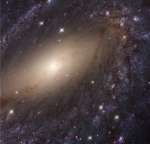 NGC 6744: Extragalactic Close Up
25.11.2022
Beautiful spiral galaxy NGC 6744 is nearly 175,000 light-years across. That's larger than the Milky Way. It lies some 30 million light-years distant in the southern constellation Pavo, with its galactic disk tilted towards our line of sight.
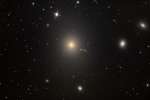 M87: Elliptical Galaxy with Jet
20.05.2010
In spiral galaxies, majestic winding arms of young stars, gas, and dust rotate in a flat disk around a bulging galactic nucleus. But elliptical galaxies seem to be simpler. Lacking gas and dust to form new stars, their randomly swarming older stars, give them an ellipsoidal (egg-like) shape. Still, elliptical galaxies can be very large.
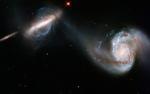 Peculiar Arp 87
1.11.2007
A cosmic bridge of stars, gas, and dust stretches for over 75,000 light-years and joins this peculiar pair of galaxies cataloged as Arp 87. The bridge is strong evidence that these two immense star systems have passed close to each other and experienced violent tides induced by mutual gravity.
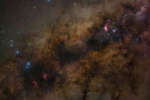 Sagittarius and the Central Milky Way
19.05.2009
What does the center of our Milky Way Galaxy look like? In visible light, no one knows! It is not possible to see the Galactic center in light our eyes are sensitive to because the thick dust in the plane of our Galaxy obscures it.
 Counting Stars in the Infrared Sky
19.07.2002
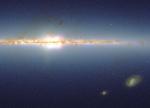
The bulging center of our Milky Way Galaxy, dark cosmic clouds, the thin galactic plane, and even nearby galaxies are easy to spot in this sky view. But each pixel in the digital image is actually based on star counts alone -- as derived from the Two Micron All Sky Survey (2MASS) database.
 M89: Elliptical Galaxy with Outer Shells and Plumes
14.06.2017
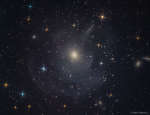
Can you see them? This famous Messier object M89, a seemingly simple elliptical galaxy, is surrounded by faint shells and plumes. The cause of the shells is currently unknown, but possibly tidal tails related to debris left over from absorbing numerous small galaxies in the past billion years.
 Sagittarius and the Central Milky Way
5.06.1996
What does the center of our Milky Way Galaxy look like? No one knows! It is not possible to see the Galactic center in light our eyes are sensitive to because the thick dust in the plane of our Galaxy obscures it.
 The Bubbling Cauldron of NGC 3079
22.08.2001
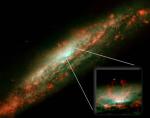
Edge-on spiral galaxy NGC 3079 is a mere 50 million light-years away toward the constellation Ursa Major. Shown in this stunning false-color Hubble Space Telescope image, the galaxy's disk - composed of spectacular star clusters in winding spiral arms and dramatic dark lanes of dust - spans some 70,000 light-years.
 The Bubbling Cauldron of NGC 3079
16.10.2004
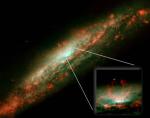
Edge-on spiral galaxy NGC 3079 is a mere 50 million light-years away toward the constellation Ursa Major. Shown in this stunning false-color Hubble Space Telescope image, the galaxy's disk - composed of spectacular star clusters in winding spiral arms and dramatic dark lanes of dust - spans some 70,000 light-years.
 Arp 87: Merging Galaxies from Hubble
9.12.2015
This dance is to the death. Along the way, as these two large galaxies duel, a cosmic bridge of stars, gas, and dust currently stretches over 75,000 light-years and joins them. The bridge...
|
January February March April May June July August September October |
|||||||||||||||||||||||||||||||||||||||||||||||||