
|
You entered: infrared
 APOD: 2025 April 9 Б HH 49: Interstellar Jet from Webb
9.04.2025
What's at the tip of this interstellar jet? First let's consider the jet: it is being expelled by a star system just forming and is cataloged as Herbig-Haro 49 (HH 49). The star system expelling this jet is not visible -- it is off to the lower right.
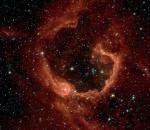 RCW 79: Stars in a Bubble
15.04.2005
A cosmic bubble of gas and dust, RCW 79 has grown to about 70 light-years in diameter, blown by the winds and radiation from hot young stars. Infrared light from the dust embedded in the nebula is tinted red in this gorgeous false-color view from the Spitzer Space Telescope.
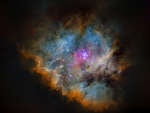 NGC 281: Starless with Stars
19.11.2021
In visible light the stars have been removed from this narrow-band image of NGC 281, a star forming region some 10,000 light-years away toward the constellation Cassiopeia. Stars were digitally added back to the resulting starless image though.
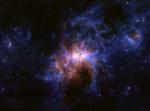 Dusty Environs of Eta Carinae
10.10.2002
Eta Car is a massive star, but it's not as bright as it used to be. Now only easily visible in binoculars or a small telescope, Eta Carinae has a history of spectacular flaring and fading behavior.
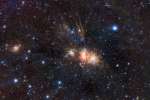 Vista with NGC 2170
15.10.2010
Drifting through the one-horned constellation Monoceros, these dusty streamers and new born stars are part of the active Monoceros R2 star-forming region, embedded in a giant molecular cloud. The cosmic scene was recorded by the VISTA survey telescope in near-infrared light.
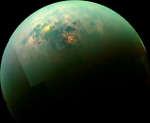 Titan Seas Reflect Sunlight
1.02.2015
Why would the surface of Titan light up with a blinding flash? The reason: a sunglint from liquid seas. Saturn's moon Titan has numerous smooth lakes of methane that, when the angle is right, reflect sunlight as if they were mirrors.
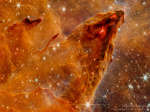 M16: A Star Forming Pillar from Webb
6.12.2022
WhatБs happening inside this interstellar mountain? Stars are forming. The mountain is actually a column of gas and dust in the picturesque Eagle Nebula (M16). A pillar like this is so low in density that you could easily fly though it -- it only appears solid because of its high dust content and great depth.
 APOD: 2024 November 26 Б The Sombrero Galaxy from Webb and Hubble
26.11.2024
This floating ring is the size of a galaxy. In fact, it is a galaxy -- or at least part of one: the photogenic Sombrero Galaxy is one of the largest galaxies in the nearby Virgo Cluster of Galaxies.
 APOD: 2025 September 8 Б IRAS 04302: Butterfly Disk Planet Formation
8.09.2025
This butterfly can hatch planets. The nebula fanning out from the star IRAS 04302+2247 may look like the wings of a butterfly, while the vertical brown stripe down the center may look like the butterfly's body -- but together they indicate an active planet-forming system.
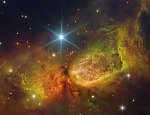 Star Forming Region S106
7.11.2011
Massive star IRS 4 is beginning to spread its wings. Born only about 100,000 years ago, material streaming out from this newborn star has formed the nebula dubbed Sharpless 2-106 Nebula (S106), pictured above.
|
January February March April May June July August September October |
|||||||||||||||||||||||||||||||||||||||||||||||||