
|
You entered: night sky
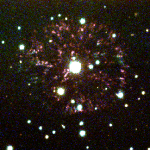 The Firework Nebula
4.07.1995
The Firework Nebula, known to astronomers as "GK Per", is the result of a type of stellar explosion called a nova. In a nova, a very compact star called a white dwarf blasts away gas that had accumulated on its surface.
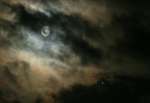 Moons and Jupiter
14.07.2009
Earth's Moon and planet Jupiter made a beautiful pairing in the night sky late last week. This skyscape recorded on July 11 from Brittany in north western France captures the bright conjunction through a cloud bank.
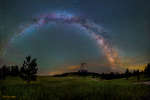 Milky Way over Devils Tower
30.10.2014
A mysterious formation known as Devils Tower rises into the dark above northeastern Wyoming's prairie landscape in this 16 frame panoramic view. Seen against the night sky's thin, pale clouds and eerie...
 Aurora Australis
4.07.2015
Not fireworks, these intense shimmering lights still danced across Earth's night skies late last month, seen here above the planet's geographic south pole. The stunning auroral displays were triggered as a coronal mass ejection blasted from the Sun days earlier impacted the magnetosphere, beginning a widespread geomagnetic storm.
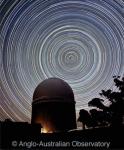 Star Trails in Southern Skies
15.07.2000
As the Earth spins on its axis, the stars seem to rotate around us. This motion produces the beautiful concentric arcs traced out by the stars in this time exposure of the southern hemisphere night sky. In the foreground is the dome of the Anglo-Australian Telescope in central New South Wales, Australia.
 Proxima Centauri: The Closest Star
15.07.2002
What is the closest star to our Sun? It is Proxima Centauri, the nearest member of the Alpha Centauri triple star system. Light takes only 4.22 years to reach us from Proxima Centauri. This...
 Full Moon Crossing
14.10.2006
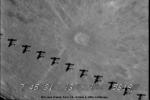
On October 6th, a nearly full perigee Moon shone in Earth's night sky. The bright moonlight, accurate planning, and proper equipment resulted in this amazing composite featuring sharp silhouettes of the International Space Station (ISS) as it rapidly crossed (right to left) in front of the lunar disk.
 Comet SOHO and Nebulae in Orion
4.06.1998
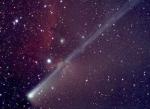
Astrophotographer Michael Horn captured this gorgeous view of comet SOHO in the dark night sky above Wandibindle, Queensland, Australia on May 23rd. On this date, comet SOHO was moving against the background of the nebula-rich constellation of Orion.
 APOD: 2023 December 18 Б The Same Color Illusion
18.12.2023
Are squares A and B the same color? They are! To verify this, either run your cursor over the image or click here to see them connected. The featured illusion, an example...
 A Red Dome Under the Big Dipper
21.08.2007
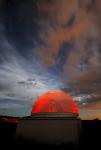
Why would the dome of a telescopic observatory appear translucent red? As one of the telescopes of the Etscorn Observatory of New Mexico Tech waited to inspect small portions of the night sky, playful observers decided to make this unusual image.
|
January February March April May June July August September October |
|||||||||||||||||||||||||||||||||||||||||||||||||