
|
You entered: nucleus
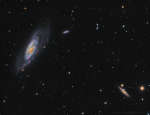 A View Toward M106
20.06.2019
Big, bright, beautiful spiral, Messier 106 dominates this cosmic vista. The nearly two degree wide telescopic field of view looks toward the well-trained constellation Canes Venatici, near the handle of the Big Dipper. Also...
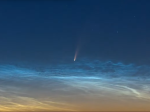 Comet NEOWISE Rising over the Adriatic Sea
26.07.2022
This sight was worth getting out of bed early. Two years ago this month, Comet C/2020 F3 (NEOWISE) rose before dawn to the delight of northern sky enthusiasts awake that early. Up before sunrise...
 APOD: 2023 May 3 Б Centaurus A: A Peculiar Island of Stars
3.05.2023
Galaxies are fascinating. In galaxies, gravity alone holds together massive collections of stars, dust, interstellar gas, stellar remnants and dark matter. Pictured is NGC 5128, better known as Centaurus A. Cen A is the fifth brightest galaxy on the sky and is located at a distance of about 12 million light years from Earth.
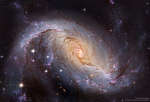 NGC 1672: Barred Spiral Galaxy from Hubble
9.10.2018
Many spiral galaxies have bars across their centers. Even our own Milky Way Galaxy is thought to have a modest central bar. Prominently barred spiral galaxy NGC 1672, featured here, was captured in spectacular detail in an image taken by the orbiting Hubble Space Telescope.
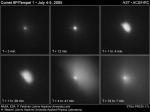 Deep Impact on Comet Tempel 1 from Hubble
18.07.2005
It was a human-made event visible across the Solar System. At the direction of terrestrial scientists, a refrigerator-sized probe from the Deep Impact mission struck Comet Tempel 1 on July 4 at over 35,000 kilometers per hour.
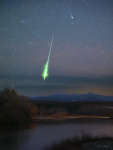 The Comet and the Fireball
20.12.2021
This picture was supposed to feature a comet. Specifically, a series of images of the brightest comet of 2021 were being captured: Comet Leonard. But the universe had other plans. Within a fraction of a second, a meteor so bright it could be called a fireball streaked through just below the comet.
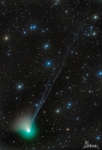 APOD: 2023 January 9 Б Tails of Comet ZTF
9.01.2023
Comet ZTF may become visible to the unaided eye. Discovered early last year, this massive snowball has been brightening as it approaches the Sun and the Earth. C/2022 E3 (ZTF) will be closest...
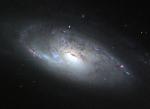 M106: A Spiral Galaxy with a Strange Core
15.02.2000
What's happening at the center of spiral galaxy M106? A swirling disk of stars and gas, M106's appearance is dominated by two bright spiral arms and dark dust lanes near the nucleus. Bright newly formed stars near their outer tips distinguish the spiral arms in the above photograph.
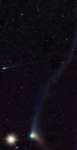 Comets and Bright Star
6.01.2016
This timely, telescopic, two panel mosaic spans about 10 full moons across planet Earth's predawn skies. Recorded as the year began from Tenerife, Canary Islands, near the top of the frame are the faint coma and tail of Comet Borrelly (P/19).
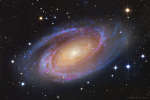 Bright Spiral Galaxy M81
17.09.2017
One of the brightest galaxies in planet Earth's sky is similar in size to our Milky Way Galaxy: big, beautiful M81. This grand spiral galaxy can be found toward the northern constellation of the Great Bear (Ursa Major).
|
January February March April May June July August September |
|||||||||||||||||||||||||||||||||||||||||||||||||