
|
You entered: rings
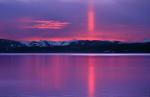 A Sun Pillar in Red and Violet
5.02.2006
Sometimes the unknown is beautiful. In 2000 February near Lake Tahoe, Nevada, two amateur photographers noticed an unusual red column of light rise mysteriously from a setting sun. During the next few minutes, they were able to capture the pillar and a photogenic sunset on film.
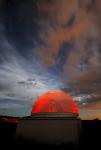 A Red Dome Under the Big Dipper
21.08.2007
Why would the dome of a telescopic observatory appear translucent red? As one of the telescopes of the Etscorn Observatory of New Mexico Tech waited to inspect small portions of the night sky, playful observers decided to make this unusual image.
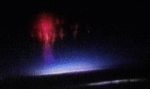 Red Sprite Lightning
11.11.1995
Recently two new types of lightning have been verified: red sprites and blue jets. These atmospheric discharges occur very high in the Earth's atmosphere - much higher than the familiar form of lightning.
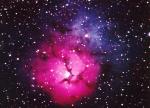 The Trifid Nebula in Red, White and Blue
8.12.1997
Three dark dust lanes give the picturesque Trifid Nebula its name. The red and blue colors of the Trifid Nebula are present in different regions and are created by different processes. A big bright star near the center of the red region appears white hot and emits light so energetic
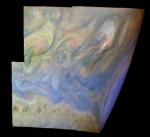 West Of The Great Red Spot
26.12.1997
The turbulent region West of Jupiter's Great Red Spot is highlighted in this recent picture constructed from data recorded by the Galileo spacecraft. The image is color coded to show cloud height and thickness; white clouds are high and thick, light blue clouds are high and thin, and reddish clouds are low.
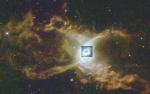 The Red Spider Planetary Nebula
6.01.1998
Oh what a tangled web a planetary nebula can weave. The Red Spider Planetary Nebula shows the complex structure that can result when a normal star ejects its outer gases and becomes a white dwarf star.
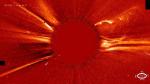 Red Sun Streaming
7.01.1997
The Sun is leaking. In fact, it is gushing: particles stream away from the Sun at hundreds of kilometers per second. Some of these particles strike the Earth and cause aurora. Most particles, however, either surround the Sun as a huge solar corona or glide into interstellar space as the solar wind.
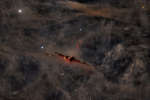 APOD: 2026 July 9 Б The Red Glow of the Cosmic Bat Nebula
9.07.2026
This Cosmic Bat wishes you a happy Summerween! This mid-year celebration of Halloween transcends hemispheres, even though summer in the Northern hemisphere is winter in the South. Contrary to its eery aura, the Cosmic Bat Nebula (LDN 43), not to be confused with the Bat Nebula (NGC 6995), is a vibrant birthplace for stars.
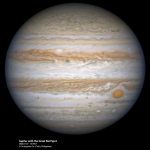 Jupiter with the Great Red Spot
10.01.2026
Jupiter reaches its 2026 opposition today, January 10. That puts our Solar System's most massive planet opposite the Sun and near its closest and brightest for viewing from planet Earth. In fact, captured...
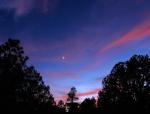 Red, White, and Blue Sky
4.07.2007
Contrasting colors in this beautiful sunset sky were captured on June 30 from Clear Creek Canyon Observatory in central Arizona, USA. The twilight scene includes brilliant Venus as the evening star, with a bright Saturn just above it, shining through thin clouds.
|
January February March April May June July August September October |
|||||||||||||||||||||||||||||||||||||||||||||||||