
|
You entered: ring
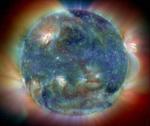 Solstice Celebration
21.06.2000
Season's greetings! At 01:48 Universal Time on June 21 the Sun reaches its northernmost point in planet Earth's sky marking a season change and the first solstice of the year 2000. In celebration, consider this delightfully detailed, brightly colored image of the active Sun.
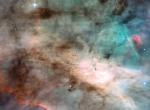 In the Center of the Omega Nebula
1.05.2002
In the depths of the dark clouds of dust and molecular gas known as the Omega Nebula, stars continue to form. The above image from the Hubble Space Telescope's newly installed Advanced Camera for Surveys shows unprecedented detail in the famous star-forming region.
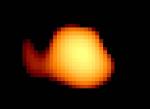 Resolving Mira
13.08.1997
Most stars appear only as points of light. Recently, Betelgeuse became the second star, after our Sun, to have it surface resolved. Now add Mira to the list. Mira A is a red giant star undergoing dramatic pulsations, causing it to become more than 100 times brighter over the course of a year.
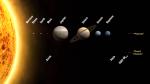 Eight Planets and New Solar System Designations
28.08.2006
How many planets are in the Solar System? This popular question now has a new formal answer according the International Astronomical Union (IAU): eight. Last week, the IAU voted on a new definition for planet and Pluto did not make the cut.
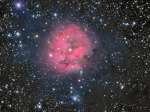 IC 5146: The Cocoon Nebula
27.08.2008
Inside the Cocoon Nebula is a newly developing cluster of stars. Cataloged as IC 5146, the beautiful nebula is nearly 15 light-years wide, located some 4,000 light years away toward the northern constellation Cygnus.
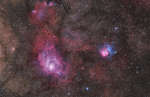 A Sagittarius Triplet
1.06.2012
These three bright nebulae are often featured in telescopic tours of the constellation Sagittarius and the crowded starfields of the central Milky Way. In fact, 18th century cosmic tourist Charles Messier cataloged two of them; M8, the large nebula left of center, and colorful M20 on the right.
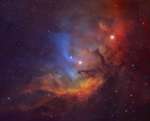 The Tulip in the Swan
26.07.2012
Framing a bright emission region this telescopic view looks out along the plane of our Milky Way Galaxy toward the nebula rich constellation Cygnus the Swan. Popularly called the Tulip Nebula the glowing cloud of interstellar gas and dust is also found in the 1959 catalog by astronomer Stewart Sharpless as Sh2-101.
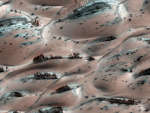 Dark Sand Cascades on Mars
25.11.2012
They might look like trees on Mars, but they're not. Groups of dark brown streaks have been photographed by the Mars Reconnaissance Orbiter on melting pinkish sand dunes covered with light frost. The above image was taken in 2008 April near the North Pole of Mars.
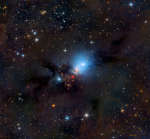 NGC 1333 Stardust
6.03.2014
NGC 1333 is seen in visible light as a reflection nebula, dominated by bluish hues characteristic of starlight reflected by dust. A mere 1,000 light-years distant toward the heroic constellation Perseus, it lies at the edge of a large, star-forming molecular cloud.
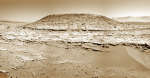 Curiosity Inspects Mt Remarkable on Mars
7.05.2014
What has the Curiosity rover come across on Mars? Dubbed Mount Remarkable, the rolling robot has chanced upon this notable 5-meter tall mound during its continuing journey around and, eventually, up 5.5-kilometer high Mt. Sharp.
|
January February March April May June July August September October |
|||||||||||||||||||||||||||||||||||||||||||||||||