
|
You entered: dark
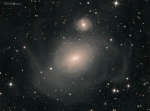 NGC 1316: After Galaxies Collide
9.09.2015
Astronomers turn detectives when trying to figure out the cause of startling sights like NGC 1316. Their investigation indicates that NGC 1316 is an enormous elliptical galaxy that started, about 100 million years ago, to devour a smaller spiral galaxy neighbor, NGC 1317, just above it.
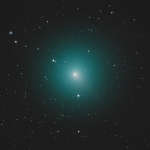 Comet 46P Wirtanen
15.11.2018
Periodic Comet 46P/Wirtanen is now the brightest comet in the night sky, but too faint to be seen by eye. From dark sky sites it could just become naked-eye visible though, as it's 5.4 year long looping orbit takes it closest to Earth and the Sun in mid December.
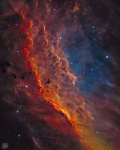 NGC 1499: The California Nebula
10.03.2021
Could Queen Calafia's mythical island exist in space? Perhaps not, but by chance the outline of this molecular space cloud echoes the outline of the state of California, USA. Our Sun has its home within the Milky Way's Orion Arm, only about 1,000 light-years from the California Nebula.
 Solar Eclipse from a Ship
29.04.2023
Along a narrow path that mostly avoided landfall, the shadow of the New Moon raced across planet Earth's southern hemisphere on April 20 to create a rare annular-total or hybrid solar eclipse. From...
 Along the Taurus Molecular Cloud
23.11.2023
The cosmic brush of star formation composed this interstellar canvas of emission, dust, and dark nebulae. A 5 degree wide telescopic mosaic, it frames a region found north of bright star Aldebaran on the sky, at an inner wall of the local bubble along the Taurus molecular cloud.
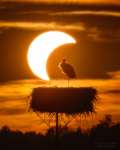 The Eclipse and the Stork
3.09.2026
How do animals react to a total solar eclipse? The featured image shows a stork roosting on her nest in Poland at a partial phase of the recent total solar eclipse.
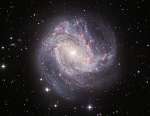 M83: The Thousand Ruby Galaxy
27.09.2008
Big, bright, and beautiful, spiral galaxy M83 lies a mere twelve million light-years away, near the southeastern tip of the very long constellation Hydra. Prominent spiral arms traced by dark dust lanes and blue star clusters lend this galaxy its popular name of the Southern Pinwheel.
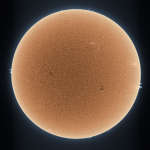 Orange Sun Simmering
9.06.2010
Even a quiet Sun can be a busy place. And over the deep Solar Minimum of the past few years, our Sun has been unusually quiet. The above image, taken last week...
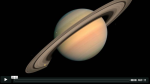 Cassini Approaches Saturn
15.03.2011
What would it look like to approach Saturn in a spaceship? One doesn't have to just imagine -- the Cassini spacecraft did just this in 2004, recording thousands of images along the way, and thousands more since entering orbit.
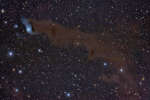 In Wolf s Cave
19.11.2011
The mysterious blue reflection nebula found in catalogs as VdB 152 or Ced 201 really is very faint. It lies at the tip of the long dark nebula Barnard 175 in a dusty complex that has also been called Wolf's Cave.
|
January February March April May June July August September |
|||||||||||||||||||||||||||||||||||||||||||||||||