
|
You entered: space
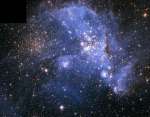 NGC 346 in the Small Magellanic Cloud
17.10.2010
How and why are all these stars forming? Found among the Small Magellanic Cloud's (SMC's) clusters and nebulae NGC 346 is a star forming region about 200 light-years across, pictured above by the Hubble Space Telescope.
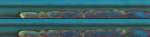 Saturn Storm Panoramas
8.07.2011
These tantalizing panoramas follow a remarkable giant storm encircling the northern hemisphere of ringed planet Saturn. Still active, the roiling storm clouds were captured in near-infrared images recorded by the Cassini spacecraft on February 26 and stitched into the high resolution, false-color mosaics.
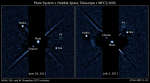 Pluto s P4
22.07.2011
Nix and Hydra were first introduced to human eyes in Hubble Space Telescope images from May 2005, as Pluto's second and third known moons. Now Hubble images have revealed a fourth satellite for the icy, dwarf planet. Provisionally designated P4, it completes an orbit of Pluto in about 31 days.
 Flyby Image of Saturns Sponge Moon Hyperion
2.06.2015
Why does this moon look like a sponge? To better investigate, NASA and ESA sent the Saturn-orbiting robotic spacecraft Cassini zooming past Saturn's moon Hyperion, once again, earlier this week. One of the images beamed back to Earth is featured above, raw and unprocessed.
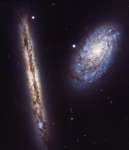 NGC 4302 and NGC 4298
20.04.2017
Seen edge-on, spiral galaxy NGC 4302 (left) lies about 55 million light-years away in the well-groomed constellation Coma Berenices. A member of the large Virgo Galaxy Cluster, it spans some 87,000 light-years, a little smaller than our own Milky Way.
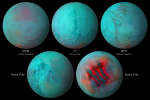 Enceladus in Infrared
23.09.2020
One of our Solar System's most tantalizing worlds, icy Saturnian moon Enceladus appears in these detailed hemisphere views from the Cassini spacecraft. In false color, the five panels present 13 years of infrared image data from Cassini's Visual and Infrared Mapping Spectrometer and Imaging Science Subsystem.
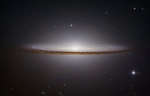 Messier 104
22.04.2022
A gorgeous spiral galaxy, Messier 104 is famous for its nearly edge-on profile featuring a broad ring of obscuring dust lanes. Seen in silhouette against an extensive central bulge of stars, the swath of cosmic dust lends a broad brimmed hat-like appearance to the galaxy suggesting a more popular moniker, the Sombrero Galaxy.
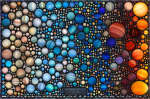 APOD: 2024 July 8 Б Exoplanet Zoo: Other Stars
7.07.2024
Do other stars have planets like our Sun? Surely they do, and evidence includes slight star wobbles created by the gravity of orbiting exoplanets and slight star dimmings caused by orbiting planets moving in front.
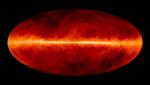 A Sky Full Of Hydrogen
12.01.2001
Interstellar space is filled with extremely tenuous clouds of gas which are mostly Hydrogen. The neutral hydrogen atom (HI in astronomer's shorthand) consists of 1 proton and 1 electron. The proton and electron spin like tops but can have only two orientations; spin axes parallel or anti-parallel.
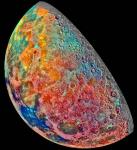 The Mineral Moon
29.08.2003
Even if the Moon really were made of green cheese it probably wouldn't look this bizarre. Still, this mosaic of 53 images was recorded by the Jupiter-bound Galileo spacecraft as it passed near our own large natural satellite in 1992.
|
January February March April May June July August September |
|||||||||||||||||||||||||||||||||||||||||||||||||