
|
You entered: color
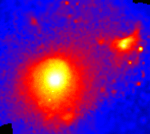 The Virgo Cluster: Hot Plasma and Dark Matter
19.04.1996
This ROSAT image of the Virgo cluster of galaxies reveals a hot X-ray emitting plasma or gas with a temperature of 10-100 million degrees pervading the cluster. False colors have been used to represent the intensity of X-ray emission.
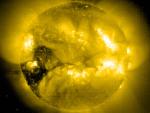 Coronal Holes on the Sun
18.03.2003
The ominous, dark shapes haunting the left side of the Sun are coronal holes -- low density regions extending above the surface where the solar magnetic field opens freely into interplanetary space. Studied extensively from...
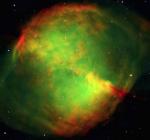 M27: Not A Comet
9.10.1998
While searching the skies above 18th century France for comets, astronomer Charles Messier diligently recorded this object as number 27 on his list of things which are definitely not comets. So what is it?
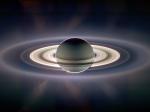 In the Shadow of Saturn
16.10.2006
In the shadow of Saturn, unexpected wonders appear. The robotic Cassini spacecraft now orbiting Saturn recently drifted in giant planet's shadow for about 12 hours and looked back toward the eclipsed Sun. Cassini saw a view unlike any other.
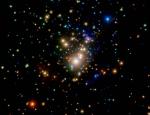 X Ray Stars of Orion
6.10.2007
The stars of Orion shine brightly in visible light in planet Earth's night sky. The constellation harbors the closest large stellar nursery, the Great Nebula of Orion, a mere 1,500 light-years away.
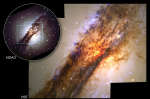 The Center of Centaurus A
7.11.2010
A fantastic jumble of young blue star clusters, gigantic glowing gas clouds, and imposing dark dust lanes surrounds the central region of the active galaxy Centaurus A. This mosaic of Hubble Space Telescope images taken in blue, green, and red light has been processed to present a natural color picture of this cosmic maelstrom.
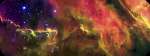 The Southern Cliff in the Lagoon
11.05.2011
Undulating bright ridges and dusty clouds cross this close-up of the nearby star forming region M8, also known as the Lagoon Nebula. A sharp, false-color composite of narrow band visible and broad band near-infrared...
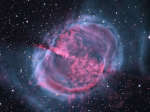 M27: The Dumbbell Nebula
27.12.2011
The first hint of what will become of our Sun was discovered inadvertently in 1764. At that time, Charles Messier was compiling a list of diffuse objects not to be confused with comets.
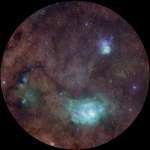 Pan STARRS and Nebulae
12.10.2012
A single image from the world's most powerful survey instrument captured this spectacular skyview. Looking toward Sagittarius, the scene spans nearly 3 degrees or six times the width of the Full Moon.
 M42: Inside the Orion Nebula
8.04.2014
The Great Nebula in Orion, an immense, nearby starbirth region, is probably the most famous of all astronomical nebulas. Here, glowing gas surrounds hot young stars at the edge of an immense interstellar molecular cloud only 1500 light-years away.
|
January February March April May June July August September October |
|||||||||||||||||||||||||||||||||||||||||||||||||