
|
You entered: Earth's moon
 Lunation
10.08.2003
Our Moon's appearance changes nightly. This time-lapse sequence shows what our Moon looks like during a lunation, a complete lunar cycle. As the Moon orbits the Earth, the half illuminated by the Sun first becomes increasingly visible, then decreasingly visible. The Moon always keeps the same face toward the Earth.
 Lunation
13.11.2005
Our Moon's appearance changes nightly. This time-lapse sequence shows what our Moon looks like during a lunation, a complete lunar cycle. As the Moon orbits the Earth, the half illuminated by the Sun first becomes increasingly visible, then decreasingly visible. The Moon always keeps the same face toward the Earth.
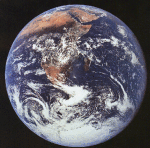 Welcome to Planet Earth
19.08.1996
Welcome to Planet Earth, the third planet from a star named the Sun. The Earth is shaped like a sphere and composed mostly of rock. Over 70 percent of the Earth's surface is water. The planet has a relatively thin atmosphere composed mostly of nitrogen and oxygen.
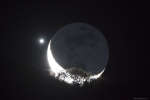 Moon and Venus Appulse over a Tree
6.02.2019
What's that bright spot near the Moon? Venus. About a week ago, Earth's Moon appeared unusually close to the distant planet Venus, an angular coincidence known as an appulse. Similar to a conjunction, which is a coordinate term, an appulse refers more generally to when two celestial objects appear close together.
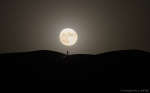 Full Moonlight
18.11.2021
A photographer in silhouette stands in bright moonlight as the Full Moon rises in this well-planned telephoto image. Of course, the Full Moon is normally the brightest lunar phase. But on November 18/19, the Full Moon's light will be dimmed during a deep partial lunar eclipse seen across much of planet Earth.
 APOD: 2024 October 8 Б Annular Eclipse over Patagonia
8.10.2024
Can you find the Sun? OK, but can you explain why thereБs a big dark spot in the center? The spot is the Moon, and the impressive alignment shown, where the Moon lines up inside the Sun, is called an annular solar eclipse.
 Lunation
8.11.1999
Our Moon's appearance changes nightly. This slow-loading time-lapse sequence shows what our Moon looks like during a lunation, a complete lunar cycle. As the Moon orbits the Earth, the half illuminated by the Sun first becomes increasingly visible, then decreasingly visible. The Moon always keeps the same face toward the Earth.
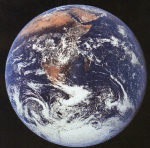 Welcome to Planet Earth
26.10.1997
Welcome to Planet Earth, the third planet from a star named the Sun. The Earth is shaped like a sphere and composed mostly of rock. Over 70 percent of the Earth's surface is water. The planet has a relatively thin atmosphere composed mostly of nitrogen and oxygen.
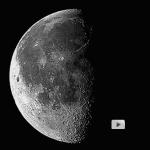 Lunation
2.09.2007
Our Moon's appearance changes nightly. This time-lapse sequence shows what our Moon looks like during a lunation, a complete lunar cycle. As the Moon orbits the Earth, the half illuminated by the Sun first becomes increasingly visible, then decreasingly visible. The Moon always keeps the same face toward the Earth.
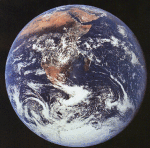 Welcome to Planet Earth
31.01.1999
Welcome to Planet Earth, the third planet from a star named the Sun. The Earth is shaped like a sphere and composed mostly of rock. Over 70 percent of the Earth's surface is water. The planet has a relatively thin atmosphere composed mostly of nitrogen and oxygen.
|
January February March April May June July August September |
|||||||||||||||||||||||||||||||||||||||||||||||||