
|
You entered: Earth orbit
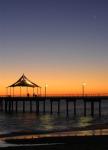 Three Planets by the Sea
2.07.2005
On Tuesday, June 28th, the setting Sun flooded the horizon with a beautiful warm light in this view from the beach beside the pier at Brighton in Adelaide, South Australia. The Sun also illuminated three planets gathered in the western sky, Mercury, Venus, and Saturn.
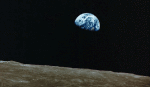 Earth Rise
24.12.1995
During the 1968 Christmas season Frank Borman, James Lovell, and William Anders flew the Apollo 8 command module From the Earth to the Moon and back (launched Dec. 21, achieved 10 lunar orbits, landed Dec. 27).
 APOD: 2025 July 18 Б ISS Meets Saturn
17.07.2025
This month, bright planet Saturn rises in evening skies, its rings oriented nearly edge-on when viewed from planet Earth. And in the early morning hours on July 6, it posed very briefly with the International Space Station when viewed from a location in Federal Way, Washington, USA.
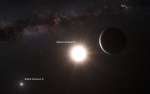 A View from Next Door
18.10.2012
Located just next door, Alpha Centauri is the closest star system to the Sun. A view from our interstellar neighbor a mere 4.3 light-years away is shown in this illustration. The Sun is at the upper right, a bright star against the background of the Milky Way.
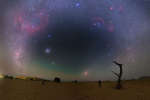 A Gegenschein Lunar Eclipse
13.10.2015
Is there anything interesting to see in the direction opposite the Sun? One night last month, there were quite a few things. First, the red-glowing orb on the lower right of the featured image is the full moon, darkened and reddened because it has entered Earth's shadow.
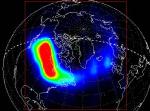 Solar Storm Causes X-Ray Aurora
18.04.1997
On April 7, the SOHO spacecraft spotted a Solar Storm ejecting a cloud of energetic particles toward planet Earth. The plasma cloud's center missed Earth, but high energy particles swept up by Earth's magnetosphere still created a geomagnetic storm!
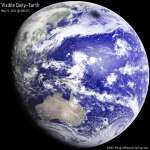 Looking Back at an Eclipsed Earth
30.05.2012
What's that dark spot on planet Earth? It's the shadow of the Moon. The above image of Earth was taken last week by MTSAT during an annular eclipse of the Sun. The dark spot appears quite unusual as clouds are white and the oceans are blue in this color corrected image.
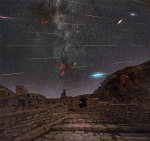 A Meteor Wind over Tunisia
15.08.2022
Does the Earth ever pass through a wind of meteors? Yes, and they are frequently visible as meteor showers. Almost all meteors are sand-sized debris that escaped from a Sun-orbiting comet or asteroid, debris that continues in an elongated orbit around the Sun.
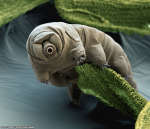 Tardigrade in Moss
25.03.2017
Is this an alien? Probably not, but of all the animals on Earth, the tardigrade might be the best candidate. That's because tardigrades are known to be able to go for decades without...
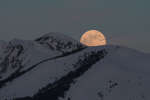 Largest Moon of 2009 Over the Alps
12.01.2009
A larger moon will not be seen this year. This past weekend, the largest full Moon of 2009 could be seen from almost any clear location on planet Earth at night. The high angular extent of the full Moon was caused by the Moon being unusually close to Earth during its full phase.
|
January February March April May June July August September October |
|||||||||||||||||||||||||||||||||||||||||||||||||