
|
You entered: galaxy formation
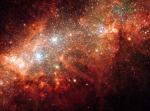 NGC 1569: Starburst in a Small Galaxy
5.02.2004
Grand spiral galaxies often seem to get all the glory, flaunting their young, bright, blue star clusters in beautiful, symmetric spiral arms. But small, irregular galaxies form stars too. In fact, as pictured here...
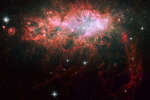 NGC 1569: Starburst in a Dwarf Irregular Galaxy
29.12.2008
Grand spiral galaxies often seem to get all the glory, flaunting their young, bright, blue star clusters in beautiful, symmetric spiral arms. But small, irregular galaxies form stars too. In fact, as pictured here...
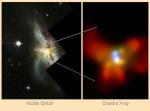 The Supermassive Black Holes of NGC 6240
28.11.2002
The Hubble optical image on the left shows NGC 6240 in the throes of a titanic galaxy - galaxy collision 400 million light-years away. As the cosmic catastrophe plays out, the merging galaxies spew forth distorted tidal tails of stars, gas, and dust and undergo frantic bursts of star formation.
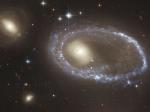 Ring Galaxy AM 0644 741 from Hubble
26.04.2004
How could a galaxy become shaped like a ring? The rim of the blue galaxy pictured on the right is an immense ring-like structure 150,000 light years in diameter composed of newly formed, extremely bright, massive stars.
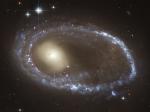 Ring Galaxy AM 0644 741 from Hubble
22.10.2005
How could a galaxy become shaped like a ring? The rim of the blue galaxy pictured on the right is an immense ring-like structure 150,000 light years in diameter composed of newly formed, extremely bright, massive stars.
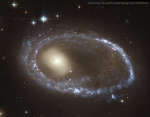 Ring Galaxy AM 0644 741 from Hubble
19.04.2015
How could a galaxy become shaped like a ring? The rim of the blue galaxy pictured on the right is an immense ring-like structure 150,000 light years in diameter composed of newly formed, extremely bright, massive stars.
 The Cartwheel Galaxy
12.06.2001
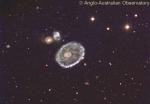
By chance, a collision of two galaxies has created a surprisingly recognizable shape on a cosmic scale. The Cartwheel Galaxy is part of a group of galaxies about 500 million light years away in the constellation Sculptor. Two smaller galaxies in the group are visible on the left of the above photograph.
 NGC 6240: Merging Galaxies
21.05.2015
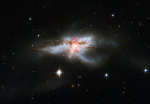
NGC 6240 offers a rare, nearby glimpse of a cosmic catastrophe in its final throes. The titanic galaxy-galaxy collision takes place a mere 400 million light-years away in the constellation Ophiuchus. The merging galaxies spew distorted tidal tails of stars, gas, and dust and undergo fast and furious bursts of star formation.
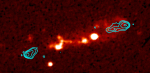 An Energetic Radio Galaxy
30.09.1995
The radio and optical emission seen in the above superposed images of the radio galaxy 3C368 indicate that energetic processes are at work. A radio galaxy is a galaxy that is visible to radio telescopes. A large radio signal usually indicates very powerful phenomena.
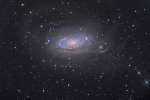 Messier 63: The Sunflower Galaxy
17.04.2008
A bright spiral galaxy of the northern sky, Messier 63 is about 25 million light-years distant in the loyal constellation Canes Venatici. Also cataloged as NGC 5055, the majestic island universe is nearly 100,000 light-years across, about the size of our own Milky Way.
|
January February March April May June July August September |
|||||||||||||||||||||||||||||||||||||||||||||||||