
|
You entered: horizon
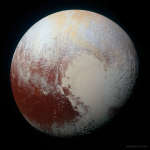 APOD: 2026 September 6 Б Pluto in Enhanced Color
6.09.2026
Pluto is more colorful than we can see. Color data and high-resolution images of our Solar System's most famous dwarf planet, taken by the robotic New Horizons spacecraft during its flyby in 2015 July, have been digitally combined to give an enhanced-color view of this ancient world sporting an unexpectedly young surface.
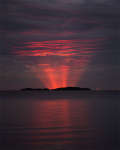 Red Crepuscular Rays from an Eclipse
30.05.2022
What's happening behind that island? Things both expected and unexpected. Expected, perhaps, the pictured rays of light -- called crepuscular rays -- originate from the Sun. Unexpected, though, the Sun was being partially eclipsed by the Moon at the time -- late last month.
 Equinox + 1
20.03.2004
Twice a year, at the Spring and Fall equinox, the Sun rises due east. In an emphatic demonstration of this celestial alignment, photographer Joe Orman recorded this inspiring image of the Sun rising exactly along the east-west oriented Western Canal, in Tempe,Arizona, USA.
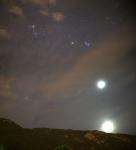 Moon and Planets Sky
26.03.2004
Look up into the sky tonight and without a telescope or binoculars you might have a view like this one of Moon, planets and stars. The lovely photo was taken on March 23rd, and captures the crescent Moon on the horizon with Venus above it. Both brilliant celestial bodies are over-exposed.
 Milky Way with Airglow Australis
4.09.2015
After sunset on September 1, an exceptionally intense, reddish airglow flooded this Chilean winter night skyscape. Above a sea of clouds and flanking the celestial Milky Way, the airglow seems to ripple and flow across the northern horizon in atmospheric waves.
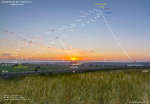 Sunset Analemma
21.06.2019
Today, the solstice is at 15:54 Universal Time, the Sun reaching the northernmost declination in its yearly journey through planet Earth's sky. A June solstice marks the astronomical beginning of summer in the northern hemisphere and winter in the south.
 ISS: Sunlight to Shadow
28.02.2008
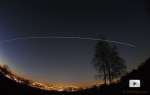
Orbiting 400,000 kilometers above the Earth, the Moon slid into Earth's shadow to begin last week's total lunar eclipse. Of course the International Space Station (ISS) slides into Earth's shadow every 90 minutes, the time it takes it to complete one orbit at an altitude of about 400 kilometers.
 Equinox Plus 1
21.03.2010
Twice a year, at the Spring and Fall equinox, the Sun rises due east. In an emphatic demonstration of this celestial alignment, photographer Joe Orman recorded this inspiring image of the Sun rising exactly along the east-west oriented Western Canal, in Tempe, Arizona, USA.
 APOD: 2024 June 9 Б How to Identify that Light in the Sky
9.06.2024
What is that light in the sky? The answer to one of humanity's more common questions may emerge from a few quick observations. For example -- is it moving or blinking?
 A Late Leonid from a Sparse Shower
25.11.2003
The 2003 Leonids Meteor Shower contained relatively few meteors. As expected and unlike the last few years, the Earth just did not pass through any dense particle streams left over by the Sun-orbiting Comet Tempel-Tuttle.
|
January February March April May June July August September October |
|||||||||||||||||||||||||||||||||||||||||||||||||