
|
You entered: nearby stars
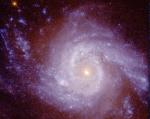 Spiral Galaxy NGC 3310 in Ultraviolet
16.01.2001
Why is NGC 3310 bursting with young stars? The brightest of these new stars are so hot that they light up this spiral galaxy not only in blue light, but in light so blue humans can't see it: ultraviolet. The Hubble Space Telescope took the above photograph in different bands of ultraviolet light.
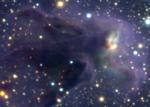 M16: Infrared Star Hunt
3.01.2002
The head of an interstellar gas and dust cloud is shown here in false-color, a near-infrared view recorded by astronomers hunting for stars within M16's Eagle Nebula. Made famous in a 1995 Hubble...
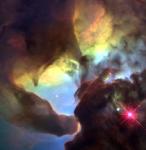 Twistin' by the Lagoon
22.01.1997
The awesome spectacle of starbirth produces extreme stellar winds and intense energetic starlight -- bombarding dusty molecular clouds inside the Lagoon Nebula (M8). At least two long funnel shaped clouds, each roughly half a light-year long, have apparently been formed by this activity.
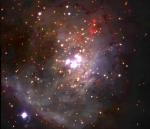 Free Floating Planets In Orion
31.03.2000
This false-colour image of the young Trapezium star cluster in the Orion Nebula was made with an infrared camera at wavelengths about twice as long as visible light. The infrared data are part...
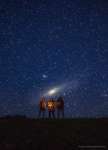 Andromeda Rising over Colombia
18.04.2016
Whats that rising over the hill? A galaxy. Never having seen a galaxy themselves, three friends of an industrious astrophotographer experienced an exhilarating night sky firsthand that featured not only the band of our Milky Way galaxy but also Milky Way's neighbor -- the Andromeda galaxy.
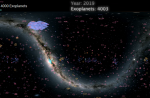 4000 Exoplanets
13.08.2022
Over 4000 planets are now known to exist outside our Solar System. Known as exoplanets, this milestone was passed last month, as recorded by NASA's Exoplanet Archive. The featured video highlights these exoplanets in sound and light, starting chronologically from the first confirmed detection in 1992 and continuing into 2019.
 The Tarantula Nebula from SuperBIT
26.04.2023
The Tarantula Nebula, also known as 30 Doradus, is more than a thousand light-years in diameter, a giant star forming region within nearby satellite galaxy the Large Magellanic Cloud. About 160 thousand light-years away, it's the largest, most violent star forming region known in the whole Local Group of galaxies.
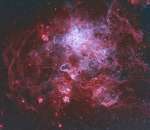 The Tarantula Nebula
15.11.2017
The Tarantula Nebula is more than a thousand light-years in diameter, a giant star forming region within nearby satellite galaxy the Large Magellanic Cloud, about 180 thousand light-years away. The largest, most violent star...
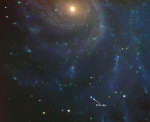 A Young Supernova in the Nearby Pinwheel Galaxy
26.08.2011
A nearby star has exploded and telescopes all over the world are turning to monitor it. The supernova, dubbed PTF 11kly, was discovered by computer only two days ago as part of the Palomar Transit Factory (PTF) sky survey utilizing the wide angle 1.2-meter Samuel Oschwin Telescope in California.
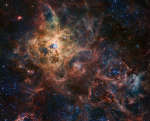 The Tarantula Nebula
25.02.2016
The Tarantula Nebula is more than a thousand light-years in diameter, a giant star forming region within nearby satellite galaxy the Large Magellanic Cloud, about 180 thousand light-years away. The largest, most violent star...
|
January February March April May June July August |
||||||||||||||||||||||||||||||||||||||||||||||||||||||||