
|
You entered: stars
 NGC 206 and the Star Clouds of Andromeda
11.04.2023
The large stellar association cataloged as NGC 206 is nestled within the dusty arms of the neighboring Andromeda galaxy along with the galaxy's pinkish star-forming regions. Also known as M31, the spiral galaxy is a mere 2.5 million light-years away.
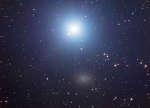 Bright Star Regulus near the Leo I Dwarf Galaxy
10.01.2012
The star near the top is so bright that it is sometimes hard to notice the galaxy toward the bottom. Pictured above, both the star, Regulus, and the galaxy, Leo I, can be found within one degree of each other toward the constellation of the Lion (Leo).
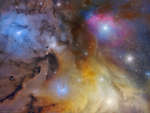 Stars, Dust, and Gas Near Antares
25.01.2022
Why is the sky near Antares and Rho Ophiuchi so dusty yet colorful? The colors result from a mixture of objects and processes. Fine dust -- illuminated from the front by starlight -- produces blue reflection nebulae. Gaseous clouds whose atoms are excited by ultraviolet starlight produce reddish emission nebulae.
 Millions of Stars in Omega Centauri
27.03.2024
Globular star cluster Omega Centauri, also known as NGC 5139, is 15,000 light-years away. The cluster is packed with about 10 million stars much older than the Sun within a volume about 150 light-years in diameter.
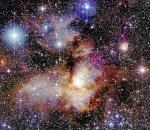 Star-Forming Region RCW38 from 2MASS
17.07.2002
The star cluster in RCW38 was hiding. Looking at the star forming region RCW38 will not normally reveal most of the stars in this cluster. The reason is that the open cluster is so young that it is still shrouded in thick dust that absorbs visible light.
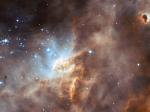 N11B: Star Cloud of the LMC
7.07.2004
Massive stars, abrasive winds, mountains of dust, and energetic light sculpt one of the largest and most picturesque regions of star formation in the Local Group of Galaxies. Known as N11, the region...
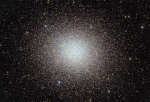 Millions of Stars in Omega Centauri
15.03.2023
Globular star cluster Omega Centauri, also known as NGC 5139, is 15,000 light-years away. The cluster is packed with about 10 million stars much older than the Sun within a volume about 150 light-years in diameter.
 APOD: 2025 April 8 Б Moon Visits Sister Stars
7.04.2025
Sometimes, the Moon visits the Pleiades. Technically, this means that the orbit of our Moon takes it directly in front of the famous Pleiades star cluster, which is far in the distance. The technical...
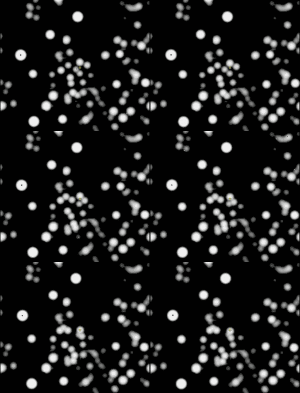 Sgr A: Fast Stars Near the Galactic Center
19.12.2000
Why are these stars moving so fast? Shown above is a time-lapse movie in infrared light detailing how stars in the central light-year of our Galaxy have moved over the past eight years. The yellow mark at the image center represents the location of a peculiar radio source named Sgr A
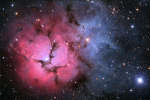 The Trifid Nebula in Stars and Dust
7.07.2009
Unspeakable beauty and unimaginable bedlam can be found together in the Trifid Nebula. Also known as M20, this photogenic nebula is visible with good binoculars towards the constellation of Sagittarius. The energetic processes of star formation create not only the colors but the chaos. The red-glowing gas results from high-energy starlight striking interstellar hydrogen gas.
|
January February March April May June July August September October |
|||||||||||||||||||||||||||||||||||||||||||||||||