
|
You entered: storm
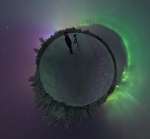 Planet Aurora Borealis
28.01.2012
Illuminated by an eerie greenish light, this remarkable little planet is covered with ice and snow and ringed by tall pine trees. Of course, this little planet is actually planet Earth, and the surrounding stars are above the horizon near Östersund, Sweden.
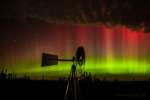 October Aurora in Prairie Skies
5.10.2013
Wind and spaceweather are transformed in this haunting night skyscape. The prairie windmill and colorful auroral display were captured on October 1, from central South Dakota, USA, as a good season for aurora hunters came with longer autumn nights.
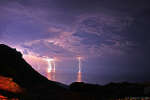 Lightning Eclipse from the Planet of the Goats
16.07.2017
Thunderstorms almost spoiled this view of the spectacular 2011 June 15 total lunar eclipse. Instead, storm clouds parted for 10 minutes during the total eclipse phase and lightning bolts contributed to the dramatic sky.
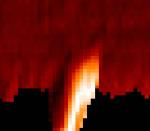 Tornadoes on the Sun
29.04.1998
Giant spinning clouds of gas, similar to Earth's tornadoes, have been found on the Sun. Solar tornadoes, however, can be larger than the entire Earth, and sustain wind gusts over 1000 times stronger than their Earth counterparts.
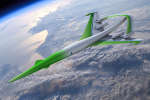 Concept Plane: Supersonic Green Machine
7.07.2010
What will passenger airplanes be like in the future? To help brain storm desirable and workable attributes, NASA sponsors design competitions. Shown here is an artist's depiction of a concept plane that has been recently suggested.
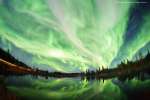 September s Aurora
23.09.2011
September's equinox arrives today at 0905 UT. As the Sun crosses the celestial equator heading south, spring begins in the southern hemisphere and autumn in the north. And though the seasonal connection is still puzzling, both spring and autumn bring an increase in geomagnetic storms.
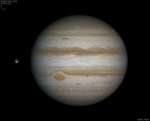 Jupiter, Ganymede, Great Red Spot
15.05.2015
In this sharp snapshot, the Solar System's largest moon Ganymede poses next to Jupiter, the largest planet. Captured on March 10 with a small telescope from our fair planet Earth, the scene also includes Jupiter's Great Red Spot, the Solar System's largest storm.
 Saturn in Infrared from Cassini
24.07.2022
Many details of Saturn appear clearly in infrared light. Bands of clouds show great structure, including long stretching storms. Also quite striking in infrared is the unusual hexagonal cloud pattern surrounding Saturn's North Pole. Each side of the dark hexagon spans roughly the width of our Earth.
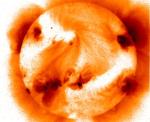 Perihelion Sun
11.01.1999
The Earth's orbit is not a perfect, sun-centered circle. At aphelion, the most distant point in Earth's orbit, the Sun is 150 million kilometers away and at perihelion, the closest point, Earth approaches the Sun to within about 147 million kilometers. While aphelion occurs in July, perihelion for planet Earth comes in January.
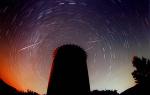 Leonids Above Torre de la Guaita
23.11.1999
The 1999 Leonids Meteor Shower came to a tremendous crescendo. Observers in Europe observed a sharp peak in the number of meteors visible around 0210 UTC during the early morning hours of November 18. Meteor counts then exceeded 1000 per hour - the minimum needed to define a true meteor storm.
|
January February March April May June July August September October |
|||||||||||||||||||||||||||||||||||||||||||||||||