
|
You entered: stars
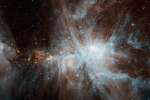 Spitzer s Orion
10.04.2010
Few cosmic vistas excite the imagination like the Orion Nebula, an immense stellar nursery some 1,500 light-years away. Spanning about 40 light-years across the region, this new infrared image from the Spitzer Space...
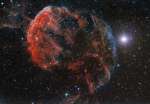 The Elusive Jellyfish Nebula
9.01.2013
Normally faint and elusive, the Jellyfish Nebula is caught in this alluring telescopic view. Drifting near bright star Eta Geminorum, at the foot of a celestial twin, the Jellyfish Nebula is seen dangling tentacles from the bright arcing ridge of emission left of center.
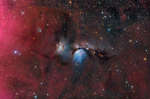 M78 Wide Field
29.12.2017
Interstellar dust clouds and glowing nebulae abound in the fertile constellation of Orion. One of the brightest, M78, is centered in this colorful, wide field view, covering an area north of Orion's belt. At a distance of about 1,500 light-years, the bluish reflection nebula is around 5 light-years across.
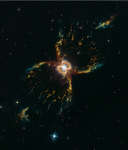 The Shape of the Southern Crab
24.04.2019
The symmetric, multi-legged appearance of the Southern Crab Nebula is certainly distinctive. About 7,000 light-years distant toward the southern sky constellation Centaurus, its glowing nested hourglass shapes are produced by the remarkable symbiotic binary star system at its center.
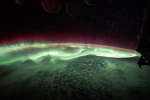 APOD: 2026 May 16 Б Aurora Slathers Up the Sky
16.05.2026
Like salsa verde on your favorite burrito, a green aurora slathers up the sky in this 2017 June 25 snapshot from the International Space Station. About 400 kilometers (250 miles) above Earth, the orbiting station is itself within the upper realm of the auroral displays.
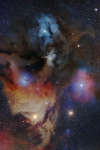 APOD: 2026 July 1 Б The Cotton Candy Clouds of Rho Ophiuchi
1.07.2026
Although they look like cotton candy, you cannot eat these clouds! Taken in Cádiz, Spain, today's image features the Rho Ophiuchi complex, a rich tapestry of young and old astronomical phenomena. This colorful cloud complex is a nearby star-forming region containing hundreds of young stellar objects, including protostars and T Tauri stars.
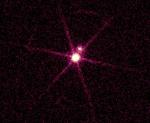 X-Rays From Sirius B
6.10.2000
In visible light Sirius A (Alpha Canis Majoris) is the brightest star in the night sky, a closely watched celestial beacon throughout recorded history. Part of a binary star system only 8 light-years away, it was known in modern times to have a small companion star, Sirius B.
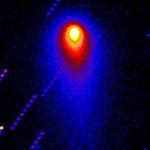 Comet Stonehouse
14.05.1998
Comets move against a field of background stars. Their apparent motion is slow but carefull tracking reveals their orbits, allowing these visitors to the inner solar system to be identified as old or new acquaintances. Recently a new comet, designated 1998 H1, was discovered by observer Patrick L.
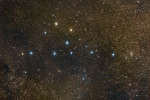 Collinder 399: The Coat Hanger
23.12.2008
Is this coat hanger a star cluster or an asterism? This cosmic hang-up has been debated over much of last century, as astronomers wondered whether this binocular-visible object is really a physically associated open cluster or a chance projection. Chance star projections are known as asterisms, an example of which is the popular Big Dipper.
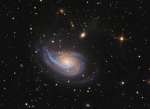 Arp 78: Peculiar Galaxy in Aries
7.07.2011
Peculiar spiral galaxy Arp 78 is found within the boundaries of the head strong constellation Aries, some 100 million light-years beyond the stars and nebulae of our Milky Way galaxy. Also known...
|
January February March April May June July August September October |
|||||||||||||||||||||||||||||||||||||||||||||||||