
|
You entered: telescope
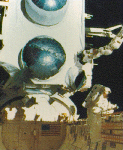 The Compton Observatory Turns Five
13.04.1996
Earlier this April, NASA's Compton Gamma Ray Observatory, completed its fifth successful year in orbit, exploring the gamma ray sky. Pictured is astronaut Jay Apt perched in the shuttle payload bay below the massive observatory. Compton is the largest civilian instrument ever flown - the whole observatory is roughly the size of a school bus.
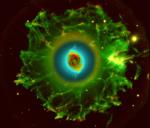 Halo of the Cat's Eye
4.09.2002
The Cat's Eye Nebula (NGC 6543) is one of the best known planetary nebulae in the sky. Its haunting symmetries are seen in the very central region of this stunning false-color picture, processed...
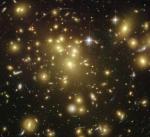 Abell 1689 Warps Space
9.01.2003
Two billion light-years away, galaxy cluster Abell 1689 is one of the most massive objects in the Universe. In this view from the Hubble Space Telescope's Advanced Camera for Surveys, Abell...
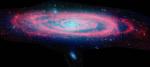 Infrared Andromeda
9.06.2006
This wide, detailed Spitzer Space Telescope view features infrared light from dust (red) and old stars (blue) in Andromeda, a massive spiral galaxy a mere 2.5 million light-years away. In fact, with over twice the diameter of our own Milky Way, Andromeda is the largest nearby galaxy.
 Fermi s Gamma ray Pulsars
9.07.2009
Born in supernovae, pulsars are spinning neutron stars, collapsed stellar cores left from the death explosions of massive stars. Traditionally identified and studied by observing their regular radio pulsations, two dozen pulsars have now been detected at extreme gamma-ray energies by the Fermi Gamma-ray Space Telescope.
 In the Center of the Omega Nebula
6.05.2012
In the depths of the dark clouds of dust and molecular gas known as the Omega Nebula, stars continue to form. The above image from the Hubble Space Telescope's Advanced Camera for Surveys shows exquisite detail in the famous star-forming region.
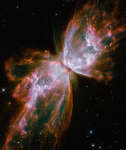 NGC 6903: The Butterfly Nebula
7.06.2013
The bright clusters and nebulae of planet Earth's night sky are often named for flowers or insects. Though its wingspan covers over 3 light-years, NGC 6302 is no exception. With an estimated surface...
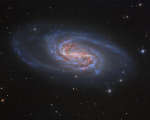 NGC 2903: A Missing Jewel in Leo
10.04.2015
Barred spiral galaxy NGC 2903 is only some 20 million light-years distant. Popular among amateur astronomers, it shines in the northern spring constellation Leo, near the top of the lion's head. That part of the constellation is sometimes seen as a reversed question mark or sickle.
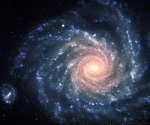 Grand Spiral Galaxy NGC 1232
26.12.2017
Galaxies are fascinating not only for what is visible, but for what is invisible. Grand spiral galaxy NGC 1232, captured in detail by one of the Very Large Telescopes, is a good example.
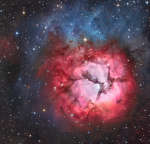 A Beautiful Trifid
12.08.2021
The beautiful Trifid Nebula is a cosmic study in contrasts. Also known as M20, it lies about 5,000 light-years away toward the nebula rich constellation Sagittarius. A star forming region in the plane...
|
January February March April May June July August September October |
|||||||||||||||||||||||||||||||||||||||||||||||||