
|
You entered: time
 Gamma Ray Moon
17.04.1999
What if you could see gamma rays (photons with more than 40 million times the energy of visible light)? If you could, the Moon would appear brighter than the Sun! This startling notion...
 Unexplained Dimmings in KIC 8462852
13.06.2016
Why does star KIC 8462852 keep wavering? Nobody knows. A star somewhat similar to our Sun, KIC 8462852 was one of many distant stars being monitored by NASA's robotic Kepler satellite to see if it had planets.
 Jupiters Magnetic Field from Juno
25.02.2020
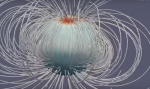
How similar is Jupiter's magnetic field to Earth's? NASA's robotic Juno spacecraft has found that Jupiter's magnetic field is surprisingly complex, so that the Jovian world does not have single magnetic poles like our Earth.
 Salt Water Remnants on Ceres
1.09.2020
Does Ceres have underground pockets of water? Ceres, the largest asteroid in the asteroid belt, was thought to be composed of rock and ice. At the same time, Ceres was known to have unusual bright spots on its surface. These bright spots were clearly imaged during Dawn's exciting approach in 2015.
 APOD: 2024 June 30 Б Earthrise: A Video Reconstruction
30.06.2024
About 12 seconds into this video, something unusual happens. The Earth begins to rise. Never seen by humans before, the rise of the Earth over the limb of the Moon occurred about 55.5 years ago and surprised and amazed the crew of Apollo 8.
 APOD: 2025 May 11 Б The Surface of Venus from Venera 14
11.05.2025
If you could stand on Venus -- what would you see? Pictured is the view from Venera 14, a robotic Soviet lander which parachuted and air-braked down through the thick Venusian atmosphere in March of 1982.
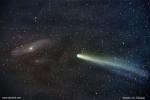 A Galaxy is not a Comet
12.04.2002
This gorgeous galaxy and comet portrait was recorded on April 5th in the skies over the Oriental Pyrenees near Figueres, Spain. From a site above 1,100 meters, astrophotographer Juan Carlos Casado used...
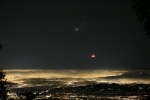 A Happy Sky Over Los Angeles
3.12.2008
Sunday, the sky seemed to smile over much of planet Earth. Visible the world over was an unusual superposition of our Moon and the planets Venus and Jupiter. Pictures taken at the right time...
 Jupiter and Saturn Pas de Deux
20.12.2001
Viewed from Earth, the solar system's planets do a cosmic dance that is hard to appreciate on any single night. But consider this well planned animated sequence combining 23 pictures taken at approximately 2 week intervals from June 2000 through May 2001.
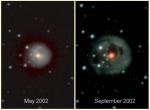 V838 Mon: Mystery Star
3.10.2002
A leading candidate for the most mysterious star found in recent times is variable star V838 Monocerotis. At a distance of about 8,000 light-years, V838 Mon was discovered to be in outburst in January of this year.
|
January February March April May June July August September |
|||||||||||||||||||||||||||||||||||||||||||||||||