
|
You entered: image
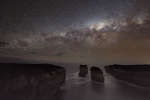 A Milky Way Shadow at Loch Ard Gorge
23.08.2010
Have you ever seen the Milky Way's glow create shadows? To do so, conditions need to be just right. First and foremost, the sky must be relatively clear of clouds so that the long band of the Milky Way's central disk can be seen.
 Star Streams of NGC 4216
27.11.2010
Some 40 million light-years distant, edge-on spiral galaxy NGC 4216 is nearly 100,000 light-years across, about the size of our own Milky Way. Found in the dense Virgo Galaxy Cluster, NGC 4216 is centered in this deep telescopic portrait flanked by fellow Virgo cluster members NGC 4206 (right) and NGC 4222.
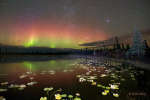 Reflected Aurora Over Alaska
12.02.2013
Some auroras can only be seen with a camera. They are called subvisual and are too faint to be seen with the unaided eye. In the above image, the green aurora were easily visible to the eye, but the red aurora only became apparent after a 20-second camera exposure.
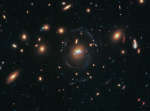 A Blue Bridge of Stars between Cluster Galaxies
15.07.2014
Why is there a blue bridge of stars across the center of this galaxy cluster? First and foremost the cluster, designated SDSS J1531+3414, contains many large yellow elliptical galaxies. The cluster's center...
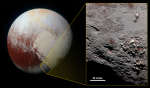 Wright Mons in Color
15.01.2016
Informally named Wright Mons, a broad mountain about 150 kilometers across and 4 kilometers high with a wide, deep summit depression is featured in this inset image captured during the New Horizons flyby of Pluto in July 2015.
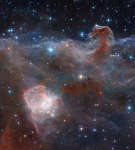 Horsehead: A Wider View
9.03.2018
Combined image data from the massive, ground-based VISTA telescope and the Hubble Space Telescope was used to create this wide perspective of the interstellar landscape surrounding the famous Horsehead Nebula. Captured at near-infrared wavelengths...
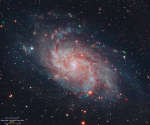 APOD: 2026 September 18 Б Messier 33: The Triangulum Galaxy
18.09.2026
The small, northern constellation Triangulum harbors this magnificent face-on spiral galaxy, Messier 33. Its popular names include the Pinwheel Galaxy or just the Triangulum Galaxy. M33 is over 50,000 light-years in diameter, third largest in the Local Group of galaxies after the Andromeda Galaxy (M31), and our own Milky Way.
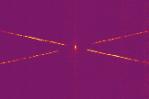 X-Ray Wind From NGC 3783
1.06.2000
A black hole is supposed to inexorably attract matter. But the intense radiation generated as material swirls and plunges into its high gravity field also heats up surrounding gas and drives it away.
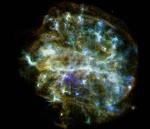 Elements in the Aftermath
26.10.2001
Massive stars spend their brief lives furiously burning nuclear fuel. Through fusion at extreme temperatures and densities surrounding the stellar core, nuclei of light elements like Hydrogen and Helium are combined to heavier elements like Carbon, Oxygen, etc. in a progression which ends with Iron.
 Planets In The Sun
5.05.2000
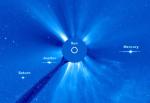
Today, all five naked-eye planets (Mercury, Venus, Mars, Jupiter, Saturn) plus the Moon and the Sun will at least approximately line-up. As viewed from planet Earth, they will be clustered within about 26 degrees, the closest alignment for all these celestial bodies since February 1962, when there was a solar eclipse!
|
January February March April May June July August September |
|||||||||||||||||||||||||||||||||||||||||||||||||