
|
You entered: orbit
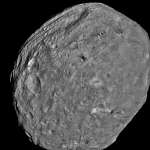 Asteroid Vesta Full Frame
2.08.2011
Why is the northern half of asteroid Vesta more heavily cratered than the south? No one is yet sure. This unexpected mystery has come to light only in the past few weeks since the robotic Dawn mission became the first spacecraft to orbit the second largest object in the asteroid belt between Mars and Jupiter.
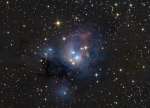 Young Suns of NGC 7129
27.10.2011
Young suns still lie within dusty NGC 7129, some 3,000 light-years away toward the royal constellation Cepheus. While these stars are at a relatively tender age, only a few million years old, it is likely that our own Sun formed in a similar stellar nursery some five billion years ago.
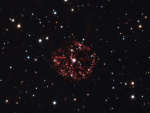 GK Per: Nova of 1901
5.11.2011
Early in the 20th century, GK Persei briefly became one of the brightest stars in planet Earth's sky, an event known as Nova Persei 1901. Documented in this modern day composite of two images from 2003 and 2011 the ejecta from the explosion, popularly called the Firework Nebula, continues to expand into space.
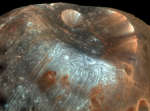 Stickney Crater
18.01.2013
Stickney Crater, the largest crater on the martian moon Phobos, is named for Chloe Angeline Stickney Hall, mathematician and wife of astronomer Asaph Hall. Asaph Hall discovered both the Red Planet's moons in 1877.
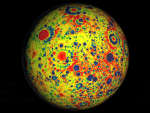 GRAIL Maps the Moons Gravity
19.03.2013
How did the Moon form? To help find out, NASA launched the twin Gravity Recovery and Interior Laboratory (GRAIL) satellites in 2011 to orbit and map the Moon's surface gravity in unprecedented detail.
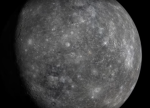 Mercury Visualized from MESSENGER
11.12.2017
What would it be like to fly over the planet Mercury? Images and data taken from NASA's robotic MESSENGER spacecraft that orbited Mercury from 2011 to 2015 have been digitally combined to envision a virtual flight that highlights much of the hot planet's surface.
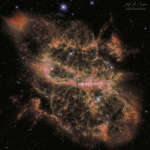 APOD: 2020 August 14 Б NGC 5189: An Unusually Complex Planetary Nebula
14.08.2020
Why is this nebula so complex? When a star like our Sun is dying, it will cast off its outer layers, usually into a simple overall shape. Sometimes this shape is a sphere, sometimes a double lobe, and sometimes a ring or a helix.
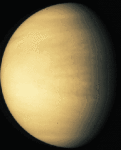 Venus: Earth's Cloudy Twin
23.09.1996
If Venus weren't so cloudy it would be more similar to Earth. This picture by the Galileo spacecraft shows just how cloudy Venus is. Venus is very similar to Earth in size and mass - and so is sometimes referred to as Earth's sister planet - but Venus has a quite different climate.
 The Gullies Of Mars
23.06.2000
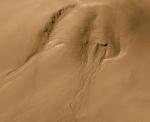
The recently revealed gullies on Mars are rare. But they may prove to be sites of present day, near surface, liquid water, holding out the tantalizing possibility of martian life. Too small to have...
 Comet 57P Falls to Pieces
2.08.2002
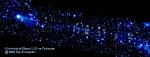
Comet 57P has fallen to pieces, at least 19 of them. Orbiting the Sun every 5.9 years or so this faint comet - also christened Comet 57P/du Toit-Neujmin-Delporte for its three 1941 co-discoverers - is simply...
|
January February March April May June July August September |
|||||||||||||||||||||||||||||||||||||||||||||||||