
|
You entered: Earth's moon
 APOD: 2023 June 12 Б The Largest Satellites of Earth
12.06.2023
WhatБs that near the Moon? ItБs the International Space Station (ISS). Although the ISS may appear to be physically near the Moon, it is not Б it is physically near the Earth.
 Jupiter and the Moons
5.10.2019
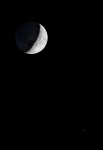
After sunset on October 3, some of the Solar System's largest moons stood low along the western horizon with the largest planet. Just after nightfall, a pairing of the Moon approaching first quarter phase and Jupiter was captured in this telephoto field of view.
 A Total Lunar Eclipse Over Tajikistan
11.07.2011
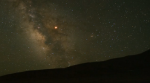
If the full Moon suddenly faded, what would you see? The answer during the total lunar eclipse last month was recorded in a dramatic time lapse video from Tajikistan. During a total lunar eclipse, the Earth moves between the Moon and the Sun, causing the moon to fade dramatically.
 Harvest Moon Eclipse
23.09.2016
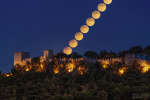
A Harvest Moon rises over Sesimbra Castle south of Lisbon in this impressive series of telephoto exposures. Captured at its full phase, the golden Moon was also gliding through the Earth's more diffuse outer shadow during September's penumbral lunar eclipse. The eclipse shading is subtle compared to a total lunar eclipse.
 Lunation
5.02.2012
Our Moon's appearance changes nightly. This time-lapse sequence shows what our Moon looks like during a lunation, a complete lunar cycle. As the Moon orbits the Earth, the half illuminated by the Sun first becomes increasingly visible, then decreasingly visible. The Moon always keeps the same face toward the Earth.
 A Total Lunar Eclipse Over Tajikistan
5.10.2014
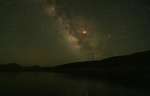
If the full Moon suddenly faded, what would you see? The answer during the total lunar eclipse of 2011 June was recorded in a dramatic time lapse video from Tajikistan. During a total lunar eclipse, the Earth moves between the Moon and the Sun, causing the moon to fade dramatically.
 A Total Lunar Eclipse Over Tajikistan
28.01.2018
If the full Moon suddenly faded, what would you see? The answer during the total lunar eclipse in 2011 was recorded in a dramatic time lapse video from Tajikistan. During a total lunar eclipse, the Earth moves between the Moon and the Sun, causing the moon to fade dramatically.
 Morning, Planets, Moon, and Montreal
20.03.2020
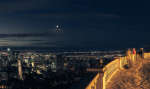
Dawn's early light came to Montreal, northern planet Earth, on March 18, the day before the vernal equinox. At the end of that nearly equal night the Moon stands above a dense constellation of urban lights in this serene city and skyscape. Of course the Moon's waning crescent faces toward the rising Sun.
 Diamond in the Sky
18.12.2020
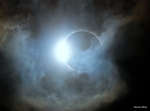
When the shadow of the Moon raced across planet Earth's southern hemisphere on December 14, sky watchers along the shadow's dark central path were treated to the only total solar eclipse of 2020. During the New Moon's shadow play this glistening diamond ring was seen for a moment, even in cloudy skies.
 Lunation
18.02.2001
Our Moon's appearance changes nightly. This slow-loading time-lapse sequence shows what our Moon looks like during a lunation, a complete lunar cycle. As the Moon orbits the Earth, the half illuminated by the Sun first becomes increasingly visible, then decreasingly visible. The Moon always keeps the same face toward the Earth.
|
January February March April May June July August September |
|||||||||||||||||||||||||||||||||||||||||||||||||