
|
You entered: Orion Nebula
 APOD: 2026 May 14 Б The Messier Catalog at Uniform Scale
13.05.2026
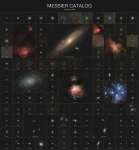
What are some of the most interesting astronomical objects you can see in the night sky? Armed with a good pair of binoculars or a small telescope, if you live in the Northern Hemisphere, you can look for the very popular objects in the Messier Catalog.
 The Heart Of Orion
6.05.2000
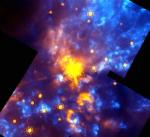
Newborn stars lie at at the heart of the the Orion Nebula, hidden from view by the dust and gas of the giant Orion Molecular Cloud number 1 (OMC-1). Sensitive to invisible infrared...
 The Dark Horsehead Nebula
28.12.2000
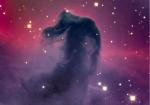
While drifting through the cosmos, sculpted by stellar winds and radiation, this magnificent interstellar dust cloud has chanced to assume a recognizable shape. Fittingly named The Horsehead Nebula it is embedded in the immense complex of star forming gas and dust surrounding the Orion Nebula some 1,500 light-years distant.
 Spitzer's Orion
30.08.2019
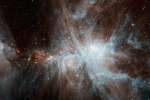
Few cosmic vistas excite the imagination like the Orion Nebula, an immense stellar nursery some 1,500 light-years away. Spanning about 40 light-years across the region, this infrared image from the Spitzer Space Telescope...
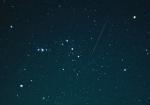 A 2000 Leonid Through Orion
19.11.2000
The Leonid Meteor Shower this year could be described as good but not great. During November 17 and 18 the Earth crossed through several streams of sand-sized grit left orbiting the Sun by Comet Tempel-Tuttle. Several distinct peaks in meteor activity were reported, with
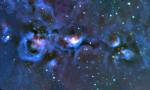 NGC 6334: The Bear Claw Nebula
6.04.1999
NGC 6334 is a cloud of gas and dust that appears to be forming massive stars. At 5500 light-years away, the Bear Claw Nebula, as it has also been dubbed, is more than three times as distant as the Orion Nebula, but still close enough for detailed study.
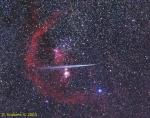 Rocket Fuel
15.11.2007
This gorgeous image of Orion shows off the constellation's young stars and cosmic clouds of hydrogen gas and dust. Made with a film camera tracking the stars on November 11, the exposure lasted some 40 minutes.
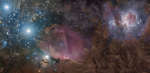 Orion in Gas, Dust, and Stars
29.09.2009
The constellation of Orion holds much more than three stars in a row. A deep exposure shows everything from dark nebula to star clusters, all imbedded in an extended patch of gaseous wisps in the greater Orion Molecular Cloud Complex.
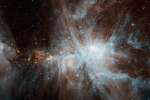 Spitzer s Orion
10.04.2010
Few cosmic vistas excite the imagination like the Orion Nebula, an immense stellar nursery some 1,500 light-years away. Spanning about 40 light-years across the region, this new infrared image from the Spitzer Space...
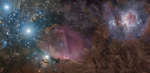 Orion in Gas, Dust, and Stars
12.02.2012
The constellation of Orion holds much more than three stars in a row. A deep exposure shows everything from dark nebula to star clusters, all embedded in an extended patch of gaseous wisps in the greater Orion Molecular Cloud Complex.
|
January February March April May June July August September October |
|||||||||||||||||||||||||||||||||||||||||||||||||