
|
You entered: Saturn's Moon
 APOD: 2025 April 30 Б A Happy Sky over Bufa Hill in Mexico
30.04.2025
Sometimes, the sky itself seems to smile. A few days ago, visible over much of the world, an unusual superposition of our Moon with the planets Venus and Saturn created just such an iconic facial expression.
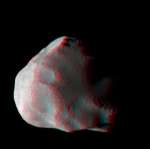 Stereo Helene
15.06.2019
Get out your red/blue glasses and float next to Helene, small, icy moon of Saturn. Appropriately named, Helene is one of four known Trojan moons, so called because it orbits at a Lagrange point. A Lagrange point is a gravitationally stable position near two massive bodies, in this case Saturn and larger moon Dione.
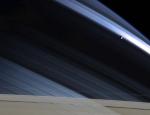 Mimas, Rings, and Shadows
2.12.2004
Caught in sunlight, icy moon Mimas shines above a broad shadow across gas giant Saturn. In this remarkable image from the Cassini spacecraft, tiny Mimas is at the upper right. The broad shadow across...
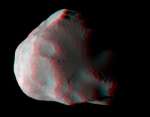 Stereo Helene
23.06.2011
Get out your red/blue glasses and float next to Helene, small, icy moon of Saturn. Appropriately named, Helene is one of four known Trojan moons, so called because it orbits at a Lagrange point. A Lagrange point is a gravitationally stable position near two massive bodies, in this case Saturn and larger moon Dione.
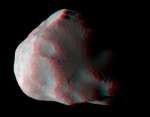 Stereo Helene
5.01.2013
Get out your red/blue glasses and float next to Helene, small, icy moon of Saturn. Appropriately named, Helene is one of four known Trojan moons, so called because it orbits at a Lagrange point. A Lagrange point is a gravitationally stable position near two massive bodies, in this case Saturn and larger moon Dione.
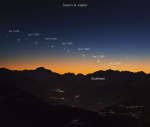 Great Conjunction: Saturn and Jupiter Converge
15.12.2020
It's happening. Saturn and Jupiter are moving closer and will soon appear in almost exactly the same direction. Coincidentally, on the night of the December solstice -- the longest night of the year in the north and the longest day in the south -- the long-awaited Great Conjunction will occur.
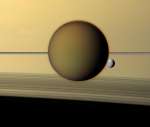 Ringside with Titan and Dione
5.01.2012
Orbiting in the plane of Saturn's rings, Saturnian moons have a perpetual ringside view of the gorgeous gas giant planet. Of course, while passing near the ring plane the Cassini spacecraft also shares their stunning perspective.
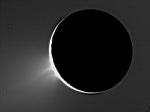 Ice Fountains Discovered on Saturns Enceladus
5.12.2005
Fountains of ice shoot out from Saturn's moon Enceladus. Clear discovery images of the fountains were made using observations from the robot Cassini spacecraft currently orbiting Saturn. During a recent pass, Cassini was programmed to look back toward the Sun where Enceladus would appear as a thin crescent.
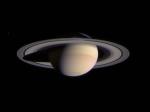 Cassini Closes in on Saturn
1.03.2004
Are they gone? They were not originally predicted to even be there. The mystery revolves around strange shadow-like spokes that appeared on Saturn's large B-ring, the large middle ring in the complex system of particles that orbits Saturn.
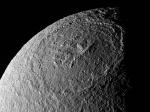 The Great Basin on Tethys
8.02.2006
Some moons wouldn't survive the collision. Tethys, one of Saturn's larger moons at about 1000 kilometers in diameter, survived the collision, but sports today the expansive impact crater Odysseus. Sometimes called...
|
January February March April May June July August September October |
|||||||||||||||||||||||||||||||||||||||||||||||||