
|
You entered: cluster gas
 LL Orionis: When Cosmic Winds Collide
15.11.2003
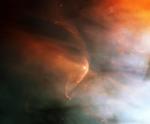
This arcing, graceful structure is actually a bow shock about half a light-year across, created as the wind from young star LL Orionis collides with the Orion Nebula flow. Adrift in Orion's stellar...
 LL Orionis: When Cosmic Winds Collide
22.05.2016
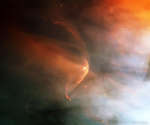
What created this great arc in space? This arcing, graceful structure is actually a bow shock about half a light-year across, created as the wind from young star LL Orionis collides with the Orion Nebula flow.
 3C294: Distant X Ray Galaxy Cluster
22.02.2001
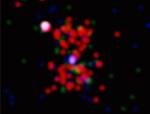
Large clusters of galaxies are the most massive objects in the universe. Astronomers now realize that a hallmark of these cosmic behemoths are gas clouds with temperatures of tens of millions of degrees that pervade the clusters and radiate strongly in x-rays.
 Stars, Dust and Nebula in NGC 2170
28.02.2007
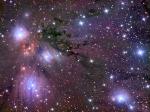
When stars form, pandemonium reigns. A textbook case is the star forming region NGC 2170. Visible above are red glowing emission nebulas of hydrogen, blue reflection nebulas of dust, dark absorption nebulas of dust, and the stars that formed from them.
 APOD: 2023 July 10 Б Stars, Dust and Nebula in NGC 6559
10.07.2023
When stars form, pandemonium reigns. A textbook case is the star forming region NGC 6559. Visible in the featured image are red glowing emission nebulas of hydrogen, blue reflection nebulas of dust, dark absorption nebulas of dust, and the stars that formed from them.
 Stars, Dust and Nebula in NGC 6559
9.05.2005
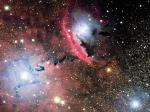
When stars form, pandemonium reigns. A textbook case is the star forming region NGC 6559. Visible above are red glowing emission nebulas of hydrogen, blue reflection nebulas of dust, dark absorption nebulas of dust, and the stars that formed from them.
 Stars, Dust and Nebula in NGC 6559
2.08.2009
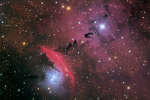
When stars form, pandemonium reigns. A textbook case is the star forming region NGC 6559. Visible above are red glowing emission nebulas of hydrogen, blue reflection nebulas of dust, dark absorption nebulas of dust, and the stars that formed from them.
 Flame Nebula Close Up
2.02.2007
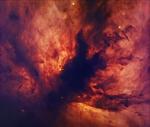
Of course, the Flame Nebula is not on fire. Also known as NGC 2024, the nebula's suggestive reddish color is due to the glow of hydrogen atoms at the edge of the giant Orion molecular cloud complex some 1,500 light-years away.
 Flame Nebula Close Up
26.11.2010
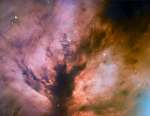
Of course, the Flame Nebula is not on fire. Also known as NGC 2024, the nebula's suggestive reddish color is due to the glow of hydrogen atoms at the edge of the giant Orion molecular cloud complex some 1,500 light-years away.
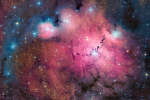 Simeis 188 in Stars, Dust and Gas
27.06.2012
When stars form, pandemonium reigns. A particularly colorful case is the star forming region Simeis 188 which houses an unusual and bright cloud arc cataloged as NGC 6559. Visible above are red glowing emission nebulas of hydrogen, blue reflection nebulas of dust, dark absorption nebulas of dust, and the stars that formed from them.
|
January February March April May June July August September |
|||||||||||||||||||||||||||||||||||||||||||||||||