
|
You entered: galaxy formation
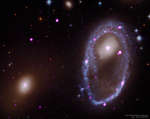 Cosmic Collision Forges Galactic Ring
17.09.2018
How could a galaxy become shaped like a ring? The rim of the blue galaxy pictured on the right is an immense ring-like structure 150,000 light years in diameter composed of newly formed, extremely bright, massive stars.
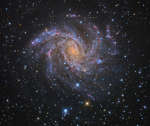 Fireworks Galaxy NGC 6946
1.01.2011
Celebrate the New Year with the Fireworks Galaxy! Also known as NGC 6946, the big, beautiful spiral galaxy is located just 10 million light-years away, behind a veil of foreground dust and stars in the high and far-off constellation of Cepheus. From our vantage point in the Milky Way Galaxy, we see NGC 6946 face-on.
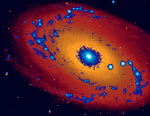 M81: A Bulging Spiral Galaxy
13.07.1996
Few stars are still forming in the old giant spiral galaxy M81. The blue regions in this picture - representing ultraviolet light - highlight regions of bright young stars and star formation and appear rare than in M74 and M33. The red regions - representing the visible light - show a large population of older, less massive stars.
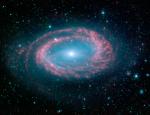 One Armed Spiral Galaxy NGC 4725
1.09.2005
While most spiral galaxies, including our own Milky Way, have two or more spiral arms, peculiar galaxy NGC 4725 has only one. In this false-color Spitzer Space Telescope infrared image, the galaxy's solo spira mirabilis is seen in red, highlighting the emission from dust clouds warmed by newborn stars.
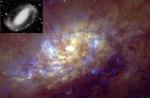 Starbirth in NGC 1808
23.03.1998
The center of galaxy NGC 1808 is bursting with new stars, but why? Being a barred spiral galaxy makes NGC 1808 somewhat similar to our own Milky Way Galaxy. But the disk of NGC 1808 (inset) is quite warped, and its center is unusually bright and blue.
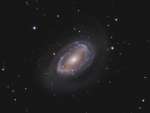 One Armed Spiral Galaxy NGC 4725
6.06.2009
While most spiral galaxies, including our own Milky Way, have two or more spiral arms, NGC 4725 seems to have only one. In this sharp color image, the solo spira mirabilis is tightly wound, traced by bluish, newborn star clusters.
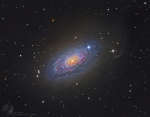 Messier 63: The Sunflower Galaxy
13.03.2014
A bright spiral galaxy of the northern sky, Messier 63 is about 25 million light-years distant in the loyal constellation Canes Venatici. Also cataloged as NGC 5055, the majestic island universe is nearly 100,000 light-years across. That's about the size of our own Milky Way Galaxy.
RGBpugh1024.preview.jpg) One Armed Spiral Galaxy NGC 4725
One Armed Spiral Galaxy NGC 4725
16.04.2015
While most spiral galaxies, including our own Milky Way, have two or more spiral arms, NGC 4725 has only one. In this sharp color composite image, the solo spira mirabilis seems to wind from a prominent ring of bluish, newborn star clusters and red tinted star forming regions.
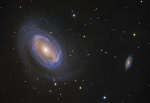 One Armed Spiral Galaxy NGC 4725
30.05.2013
While most spiral galaxies, including our own Milky Way, have two or more spiral arms, NGC 4725 has only one. In this sharp color composite image, the solo spira mirabilis seems to wind from a prominent ring of bluish, newborn star clusters and red tinted star forming regions.
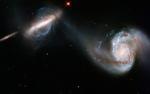 Peculiar Arp 87
1.11.2007
A cosmic bridge of stars, gas, and dust stretches for over 75,000 light-years and joins this peculiar pair of galaxies cataloged as Arp 87. The bridge is strong evidence that these two immense star systems have passed close to each other and experienced violent tides induced by mutual gravity.
|
January February March April May June July August September |
|||||||||||||||||||||||||||||||||||||||||||||||||