
|
You entered: nearby stars
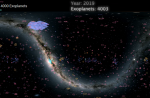 4000 Exoplanets
10.07.2019
Over 4000 planets are now known to exist outside our Solar System. Known as exoplanets, this milestone was passed last month, as recorded by NASA's Exoplanet Archive. The featured video highlights these exoplanets in sound and light, starting chronologically from the first confirmed detection in 1992.
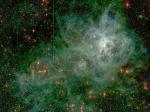 30 Doradus: The Tarantula Nebula
26.10.1999
30 Doradus is an immense star forming region in a nearby galaxy known as the Large Magellanic Cloud. Its spidery appearance is responsible for its popular name, the Tarantula Nebula, except that this tarantula is about 1,000 light-years across, and 165,000 light-years away in the southern constellation Dorado.
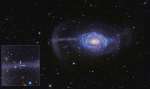 NGC 4651: The Umbrella Galaxy
2.07.2014
Spiral galaxy NGC 4651 is a mere 62 million light-years distant, toward the well-groomed northern constellation Coma Berenices. About the size of our Milky Way, this island universe is seen to have a faint umbrella-shaped structure that seems to extend (left) some 100 thousand light-years beyond the bright galactic disk.
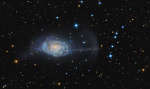 NGC 4651: The Umbrella Galaxy
15.04.2010
Spiral galaxy NGC 4651 is a mere 35 million light-years distant, toward the well-groomed constellation Coma Berenices. About 50 thousand light-years across, this galaxy is seen to have a faint umbrella-shaped structure (right) that seems to extend some 50 thousand light-years farther, beyond the bright galactic disk.
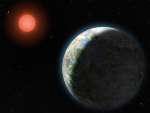 Zarmina s World
1.10.2010
A mere 20 light-years away in the constellation Libra, red dwarf star Gliese 581 has received much scrutiny by astronomers in recent years. Earthbound telescopes had detected the signatures of multiple planets orbiting...
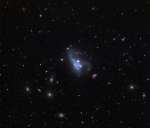 NGC 3239 and SN 2012A
27.01.2012
About 40,000 light-years across, pretty, irregular galaxy NGC 3239 lies near the center of this lovely field of galaxies in the galaxy rich constellation Leo. At a distance of only 25 million light-years...
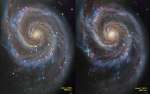 Supernovae in the Whirlpool
11.06.2011
Where do spiral galaxies keep their supernovae? Near their massive star forming regions, of course, and those regions tend to lie along sweeping blue spiral arms. Because massive stars are very short-lived, they don't have a chance to wander far from their birth place.
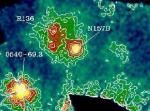 Ultra Fast Pulsar
11.02.1998
Pulsars are rotating neutron stars, born in the violent crucibles of supernova explosions. Like cosmic lighthouses, beams of radiation from surface hotspots sweep past our viewpoint creating pulses which reveal the rotation rates of these incredibly dense stellar corpses. The most famous pulsar of all is found in the nearby supernova remnant, the Crab Nebula.
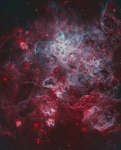 The Tarantula Zone
13.11.2020
The Tarantula Nebula, also known as 30 Doradus, is more than a thousand light-years in diameter, a giant star forming region within nearby satellite galaxy the Large Magellanic Cloud. About 180 thousand light-years away, it's the largest, most violent star forming region known in the whole Local Group of galaxies.
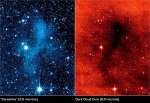 Coreshine from a Dark Cloud
30.09.2010
Stars and their planets are born in cold, dark, interstellar clouds of gas and dust. While exploring the clouds at infrared wavelengths, astronomers have made a surprising discovery -- dozens of cases where dense cloud cores shine by reflecting infrared starlight.
|
January February March April May June July August |
||||||||||||||||||||||||||||||||||||||||||||||||||||||||