
|
You entered: open cluster
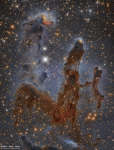 Pillars of the Eagle Nebula in Infrared
7.03.2021
Newborn stars are forming in the Eagle Nebula. Gravitationally contracting in pillars of dense gas and dust, the intense radiation of these newly-formed bright stars is causing surrounding material to boil away. This image...
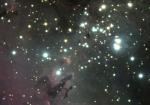 Blue Stars and Red Pillars
18.07.1997
Bright blue stars are still forming in the red pillars of the Eagle Nebula. Made famous by a picture from the Hubble Space Telescope in 1995, the Eagle Nebula shows the dramatic process of star formation. To the upper right of the nebula in the above picture lies the heart of the open cluster M16.
 APOD: 2024 November 18 Б Stars and Dust in the Pacman Nebula
18.11.2024
Stars can create huge and intricate dust sculptures from the dense and dark molecular clouds from which they are born. The tools the stars use to carve their detailed works are high energy light and fast stellar winds.
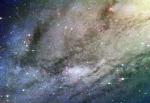 Southwest Andromeda
17.09.2001
This new image composite of the southwest region of M31 from the Subaru Telescope shows many stars, nebulae, and star clusters never before resolved. An older population of stars near Andromeda's center causes the yellow hue visible on the upper right. Young blue stars stand out in the spiral arms on the lower left.
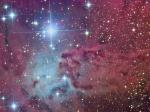 The Fox Fur Nebula
14.03.2005
The nebula surrounding bright star S Mon is filled with dark dust and glowing gas. The strange shapes originate from fine interstellar dust reacting in complex ways with the energetic light and hot gas being expelled by the young stars.
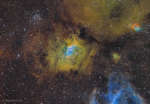 NGC 7635: Bubble in a Cosmic Sea
23.11.2016
Do you see the bubble in the center? Seemingly adrift in a cosmic sea of stars and glowing gas, the delicate, floating apparition in this widefield view is cataloged as NGC 7635 - The Bubble Nebula.
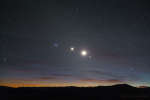 A Morning Line of Stars and Planets
11.07.2012
Early morning dog walkers got a visual treat last week as bright stars and planets appeared to line up. Pictured above, easily visible from left to right, were the Pleiades open star cluster, Jupiter, Venus, and the "Follower" star Aldebaran, all seen before a starry background.
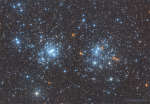 A Double Star Cluster in Perseus
22.11.2022
Few star clusters this close to each other. Visible to the unaided eye from dark sky areas, it was cataloged in 130 BC by Greek astronomer Hipparchus. Some 7,000 light-years away, this pair...
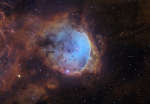 NGC 3324 in Carina
6.04.2018
This bright cosmic cloud was sculpted by stellar winds and radiation from the hot young stars of open cluster NGC 3324. With dust clouds in silhouette against its glowing atomic gas, the pocket-shaped star-forming region actually spans about 35 light-years. It lies some 7,500 light-years away toward the nebula rich southern constellation Carina.
 NGC 3324 in Carina
16.03.2019
This bright cosmic cloud was sculpted by stellar winds and radiation from the hot young stars of open cluster NGC 3324. With dust clouds in silhouette against its glowing atomic gas, the pocket-shaped star-forming region actually spans about 35 light-years. It lies some 7,500 light-years away toward the nebula rich southern constellation Carina.
|
January February March April May June July August September October |
|||||||||||||||||||||||||||||||||||||||||||||||||