
|
You entered: space station
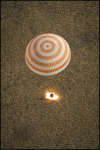 A Landing on Planet Earth
14.09.2013
With parachute deployed and retro-rockets blazing, this spacecraft landed on planet Earth on September 11 (UT) in a remote area near the town of Zhezkazgan, Kazakhstan. Seen in silhouette against the rockets' glare, the spacecraft is a Soyuz TMA-08M.
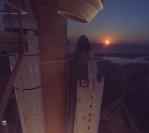 Discovery Spring
20.03.2001
Welcome to the equinox! Moving northward in Earth's sky, today the Sun crosses the celestial equator at 13:31 Universal Time bringing Spring to the north and Fall to the south. The change...
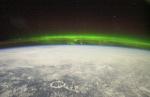 Aurora from Space
5.11.2005
From the ground, spectacular auroras seem to dance high above. But the International Space Station (ISS) orbits at nearly the same height as many auroras, sometimes passing over them, and sometimes right through them. Still, the auroral electron and proton streams pose no direct danger to the ISS.
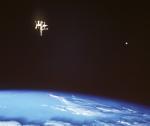 The Moons Of Earth
13.08.1998
While orbiting the planet during their June 1998 mission, the crew of the Space Shuttle Discovery photographed this view of two moons of Earth. Thick storm clouds are visible in the lovely blue planet...
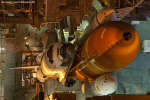 Endeavour Looking Up
2.04.2011
First flown in 1992, Endeavour, the youngest space shuttle orbiter, is being prepared for its 25th and final trip to low Earth orbit. Seen here from an exciting perspective 400 feet above the floor...
 The ISS Meets Venus
11.04.2025
Made with a telescope shaded from bright sunlight by an umbrella, on April 5 a well-planned video captured a crescent Venus shining in clear daytime skies from Shoreline, Washington, USA at 11:57AM Pacific Time. It also caught the International Space Station in this single video frame.
 Earth at Twilight
11.06.2005
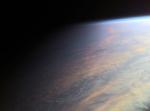
No sudden, sharp boundary marks the passage of day into night in this gorgeous view of ocean and clouds over our fair planet Earth. Instead, the shadow line or terminator is diffuse and shows the gradual transition to darkness we experience as twilight.
 Earth at Twilight
24.04.2003
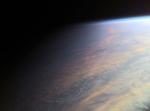
No sudden, sharp boundary marks the passage of day into night in this gorgeous view of ocean and clouds over our fair planet Earth. Instead, the shadow line or terminator is diffuse and shows the gradual transition to darkness we experience as twilight.
 Looking Back at an Eclipsed Earth
10.06.2007
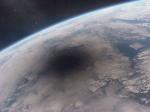
Here is what the Earth looks like during a solar eclipse. The shadow of the Moon can be seen darkening part of Earth. This shadow moved across the Earth at nearly 2000 kilometers per hour.
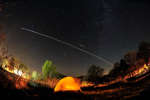 Camelopardalids and ISS
25.05.2014
From a camp on the northern shores of the Great Lake Erie, three short bright meteor streaks were captured in this composited night skyscape. Recorded over the early morning hours of May 24, the meteors are illusive Camelopardalids.
|
January February March April May June July August September October |
|||||||||||||||||||||||||||||||||||||||||||||||||