
|
You entered: planets
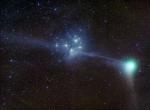 Machholz Meets the Pleiades
11.01.2005
Sweeping northward in planet Earth's sky, comet Machholz extended its long ion tail with the Pleiades star cluster in the background on January 7th. This stunning view, recorded with a telephoto lens in skies over Oberjoch, Bavaria, Germany, emphasizes faint, complex tail structures and the scene's lovely blue and green colors.
 A Total Solar Eclipse Over China
5.08.2008
What's that black dot over the Sun? The Moon. This past weekend, the Sun went dark during the day as the Moon completely covered it. The total solar eclipse was visible over a thin swath of Earth extending from northern Canada to China.
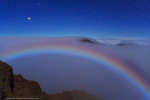 Mars and a Colorful Lunar Fog Bow
2.02.2010
Even from the top of a volcanic crater, this vista was unusual. For one reason, Mars was dazzlingly bright two weeks ago, when this picture was taken, as it was nearing its brightest time of the entire year. Mars, on the far upper left, is the brightest object in the above picture.
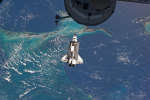 Atlantis Last Approach
13.07.2011
For the last time, the US Space Shuttle has approached the International Space Station (ISS). Following a dramatic launch from Cape Canaveral last week that was witnessed by an estimated one million people, Space Shuttle Atlantis on STS-135 lifted a small crew to a welcome rendezvous three days ago with the orbiting station.
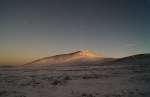 The Snows of Paranal
11.08.2011
Recorded last week, this dawn portrait of snowy mountain and starry sky captures a very rare scenario. The view does feature a pristine sky above the 2,600 meter high mountain Cerro Paranal, but clear skies over Paranal are not at all unusual.
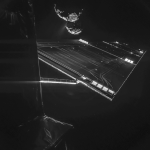 Rosetta s Selfie
16.10.2014
This Rosetta spacecraft selfie was snapped on October 7th. At the time the spacecraft was about 472 million kilometers from planet Earth, but only 16 kilometers from the surface of comet 67P/Churyumov-Gerasimenko. Looming beyond...
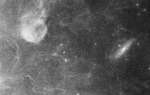 Sivan 2 to M31
3.03.2017
From within the boundaries of the constellation Cassiopeia (left) to Andromeda (right), this telescopic mosaic spans over 10 degrees in planet Earth's skies. The celestial scene is constructed of panels that are part of a high-resolution astronomical survey of the Milky Way in hydrogen-alpha light.
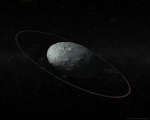 Haumea of the Outer Solar System
17.10.2017
One of the strangest objects in the outer Solar System has recently been found to have a ring. The object, named Haumea, is the fifth designated dwarf planet after Pluto, Ceres, Eris, and Makemake. Haumea's oblong shape makes it quite unusual.
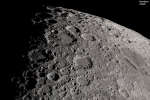 Southern Moonscape
6.02.2020
The Moon's south pole is near the top of this detailed telescopic view. Looking across the rugged southern lunar highlands it was captured from southern California, planet Earth. At the Moon's third quarter phase the lunar terminator, the sunset shadow line, is approaching from the left.
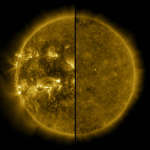 Solar Cycle 25 Begins
17.09.2020
The general trend of monthly sunspot data now confirms that the minimum of the approximately 11 year cycle of solar activity occurred in December 2019, marking the start of Solar Cycle 25. That quiet Sun, at minimum activity, appears on the right of this split hemispherical view.
|
January February March April May June July August September October |
|||||||||||||||||||||||||||||||||||||||||||||||||