
|
You entered: stars
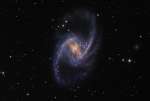 NGC 1365: Majestic Spiral with Supernova
24.11.2012
Barred spiral galaxy NGC 1365 is truly a majestic island universe some 200,000 light-years across. Located a mere 60 million light-years away toward the chemical constellation Fornax, NGC 1365 is a dominant member of the well-studied Fornax galaxy cluster.
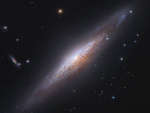 NGC 2683: Edge On Spiral Galaxy
5.02.2014
Does spiral galaxy NGC 2683 have a bar across its center? Being so nearly like our own barred Milky Way Galaxy, one might guess it has. Being so nearly edge-on, however, it is hard to tell.
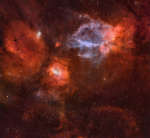 NGC 7635: Bubble in a Cosmic Sea
26.10.2017
Adrift in a cosmic sea of stars and glowing gas the delicate, floating apparition left of center in this widefield view is cataloged as NGC 7635, the Bubble Nebula. A mere 10 light-years wide, the tiny Bubble Nebula was blown by the winds of a massive star.
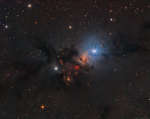 NGC 1333: Stellar Nursery in Perseus
27.03.2019
NGC 1333 is seen in visible light as a reflection nebula, dominated by bluish hues characteristic of starlight reflected by interstellar dust. A mere 1,000 light-years distant toward the heroic constellation Perseus, it lies at the edge of a large, star-forming molecular cloud.
 Grand Spiral NGC 5643
26.12.2024
Viewed face-on, grand spiral galaxy NGC 5643 has a festive appearance in this colorful cosmic portrait. Some 55 million light-years distant, the galaxy extends for over 100,000 light-years, seen within the boundaries of the southern constellation Lupus.
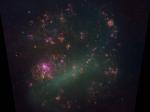 The LMC Galaxy in Glowing Gas
23.01.2006
What goes on inside of a galaxy? To help find out, astronomers from the Magellanic Cloud Emission Line Survey team imaged our neighboring LMC galaxy in spectacular detail and highlighted very specific colors of light emitted by glowing gas.
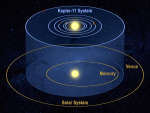 Six Worlds for Kepler 11
3.02.2011
Six worlds orbit Kepler-11, a sunlike star 2,000 light-years distant in the constellation Cygnus. The new discovery, based on data from NASA's planet hunting Kepler spacecraft, makes the Kepler-11 system the fullest exoplanetary system known.
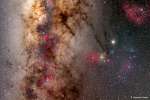 A Scorpius Sky Spectacular
4.05.2014
If Scorpius looked this good to the unaided eye, humans might remember it better. Scorpius more typically appears as a few bright stars in a well-known but rarely pointed out zodiacal constellation. To get a spectacular image like this, though, one needs a good camera, color filters, and a digital image processor.
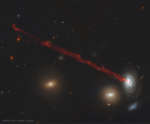 The Long Gas Tail of Spiral Galaxy D100
28.01.2019
Why is there long red streak attached to this galaxy? The streak is made mostly of glowing hydrogen that has been systematically stripped away as the galaxy moved through the ambient hot gas in a cluster of galaxies. Specifically, the galaxy is spiral galaxy D100, and cluster is the Coma Cluster of galaxies.
 NGC 2403 in Camelopardalis
3.06.2024
Magnificent island universe NGC 2403 stands within the boundaries of the long-necked constellation Camelopardalis. Some 10 million light-years distant and about 50,000 light-years across, the spiral galaxy also seems to have more than its fair share of giant star forming HII regions, marked by the telltale reddish glow of atomic hydrogen gas.
|
January February March April May June July August September October |
|||||||||||||||||||||||||||||||||||||||||||||||||