
|
You entered: telescope
 APOD Turns 17
16.06.2012
The first APOD appeared seventeen years ago today, on 1995 June 16. Although garnering only 14 page views on that day, we are proud to estimate that APOD has now served over one billion space-related images over the last 1.7 decades.
 Seyferts Sextet
10.12.2013
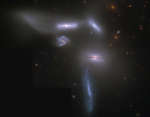
What will survive this battle of the galaxies? Known as Seyfert's Sextet, this intriguing group of galaxies lies in the head portion of the split constellation of the Snake (Serpens). The sextet actually contains only four interacting galaxies, though.
 Gravity s Grin
27.11.2015
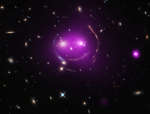
Albert Einstein's general theory of relativity, published 100 years ago this month, predicted the phenomenon of gravitational lensing. And that's what gives these distant galaxies such a whimsical appearance, seen through the looking glass of X-ray and optical image data from the Chandra and Hubble space telescopes.
 Gravity s Grin
5.08.2017
Albert Einstein's general theory of relativity, published over 100 years ago, predicted the phenomenon of gravitational lensing. And that's what gives these distant galaxies such a whimsical appearance, seen through the looking glass of X-ray and optical image data from the Chandra and Hubble space telescopes.
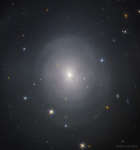 NGC 4993: The Galactic Home of an Historic Explosion
23.10.2017
That reddish dot -- it wasn't there before. It's the dot to the upper left of galaxy NGC 4993's center, do you see it? When scanning the large field of possible locations...
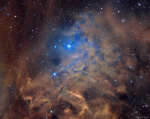 AE Aurigae and the Flaming Star Nebula
25.02.2018
Why is AE Aurigae called the flaming star? For one reason, the surrounding nebula IC 405 is named the Flaming Star Nebula because the region seems to harbor smoke, even though nothing is on fire, including interior star AE Aurigae.
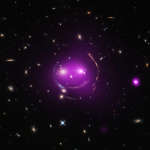 Gravity s Grin
11.05.2022
Albert Einstein's general theory of relativity, published over 100 years ago, predicted the phenomenon of gravitational lensing. And that's what gives these distant galaxies such a whimsical appearance, seen through the looking glass of X-ray and optical image data from the Chandra and Hubble space telescopes.
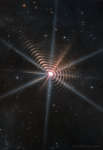 Dust Shells around WR 140 from Webb
13.10.2022
What are those strange rings? Rich in dust, the rings are likely 3D shells -- but how they were created remains a topic of research. Where they were created is well known: in a binary...
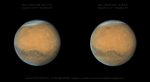 Stereo Mars
3.12.2022
Mars looks sharp in these two rooftop telescope views captured in late November from Singapore, planet Earth. At the time, Mars was about 82 million kilometers from Singapore and approaching its opposition, opposite the Sun in planet Earth's sky on December 8.
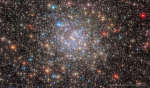 APOD: 2023 January 30 Б Globular Star Cluster NGC 6355 from Hubble
30.01.2023
Globular clusters once ruled the Milky Way. Back in the old days, back when our Galaxy first formed, perhaps thousands of globular clusters roamed our Galaxy. Today, there are less than 200 left. Over the eons, many globular clusters were destroyed by repeated fateful encounters with each other or the Galactic center.
|
January February March April May June July August September October |
|||||||||||||||||||||||||||||||||||||||||||||||||