
|
You entered: dust
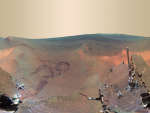 Greeley Panorama on Mars
9.07.2012
What did you do over your winter vacation? If you were the Opportunity rover on Mars, you spent four months of it stationary and perched on the northern slope of Greeley Haven -- and tilted so that your solar panels could absorb as much sunlight as possible.
 Elliptical M60, Spiral NGC 4647
14.09.2012
Giant elliptical galaxy M60 and spiral galaxy NGC 4647 do look like an odd couple in this sharp cosmic portrait from the Hubble Space Telescope. But they are found in a region of space where galaxies tend to gather, on the eastern side of the nearby Virgo Galaxy Cluster.
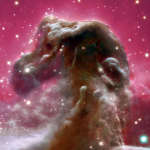 The Horsehead Nebula from Blue to Infrared
28.07.2014
One of the most identifiable nebulae in the sky, the Horsehead Nebula in Orion, is part of a large, dark, molecular cloud. Also known as Barnard 33, the unusual shape was first discovered on a photographic plate in the late 1800s.
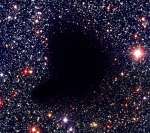 Molecular Cloud Barnard 68
13.12.2014
Where did all the stars go? What used to be considered a hole in the sky is now known to astronomers as a dark molecular cloud. Here, a high concentration of dust and molecular gas absorb practically all the visible light emitted from background stars.
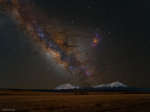 Milky Way Over the Spanish Peaks
24.05.2016
That's not lightning, and it did not strike between those mountains. The diagonal band is actually the central band of our Milky Way Galaxy, while the twin peaks are actually called the Spanish Peaks -- but located in Colorado, USA.
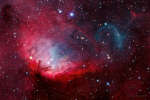 The Tulip and Cygnus X 1
16.02.2017
Framing a bright emission region, this telescopic view looks out along the plane of our Milky Way Galaxy toward the nebula rich constellation Cygnus the Swan. Popularly called the Tulip Nebula, the reddish glowing cloud of interstellar gas and dust is also found in the 1959 catalog by astronomer Stewart Sharpless as Sh2-101.
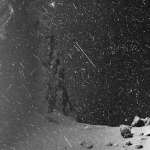 The Snows of Churyumov Gerasimenko
26.04.2018
You couldn't really be caught in this blizzard while standing by a cliff on Churyumov-Gerasimenko, also known as comet 67P. Orbiting the comet in June of 2016 the Rosetta spacecraft's narrow angle...
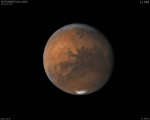 Solis Lacus: The Eye of Mars
1.10.2020
As telescopes around planet Earth watch, Mars is growing brighter in night skies, approaching its 2020 opposition on October 13. Mars looks like its watching too in this view of the Red Planet from September 22.
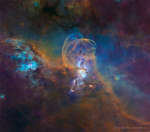 Star Forming Region NGC 3582 without Stars
20.09.2022
What's happening in the Statue of Liberty nebula? Bright stars and interesting molecules are forming and being liberated. The complex nebula resides in the star forming region called RCW 57, and besides the iconic monument, to some looks like a flying superhero or a weeping angel.
 APOD: 2023 July 9 Б Doomed Star Eta Carinae
9.07.2023
Eta Carinae may be about to explode. But no one knows when - it may be next year, it may be one million years from now. Eta Carinae's mass - about 100 times greater than our Sun - makes it an excellent candidate for a full blown supernova.
|
January February March April May June July August September October |
|||||||||||||||||||||||||||||||||||||||||||||||||