
|
You entered: time
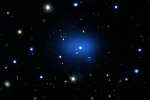 JKCS041: The Farthest Galaxy Cluster Yet Measured
28.10.2009
What if we could see back to the beginning of the universe? We can -- since it takes the age of the universe for light to cross the universe. Peering at distant objects, therefore, tells us about how the universe used to be, even near its beginning.
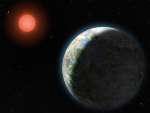 Zarmina s World
1.10.2010
A mere 20 light-years away in the constellation Libra, red dwarf star Gliese 581 has received much scrutiny by astronomers in recent years. Earthbound telescopes had detected the signatures of multiple planets orbiting...
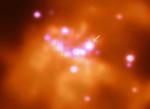 M82 s Middle Mass Black Hole
14.09.2000
Black holes are probably the most bizarre creatures in the modern astronomical zoo. And after years of pondering black holes as either stellar mass objects seen in binary star systems or enormous supermassive black holes at the centers of galaxies, astronomers now have strong evidence
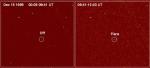 LP 944-20: A Failed Star Flares
13.07.2000
The tiny spot circled on the right actually represents a big astronomical discovery -- the first detected flare from a failed star. Failed stars, termed brown dwarfs in astronomers' parlance, are too low in mass to ignite nuclear hydrogen burning in their cores, yet
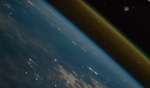 Rocket Launch as Seen from the Space Station
26.11.2018
Have you ever seen a rocket launch -- from space? A close inspection of the featured time-lapse video will reveal a rocket rising to Earth orbit as seen from the International Space Station (ISS).
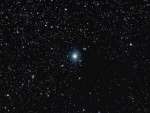 The Mystery of the Fading Star
8.01.2010
Every 27 years Epsilon Aurigae fades, remaining dim for roughly two years before growing bright again. Since the 19th century, astronomers have studied the mystery star, eventually arguing that Epsilon Aur, centered in this telescopic skyview, was actually undergoing a long eclipse by a dark companion object.
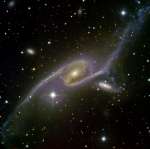 Giant Galaxy NGC 6872
3.04.2011
Over 400,000 light years across NGC 6872 is an enormous spiral galaxy, at least 4 times the size of our own, very large, Milky Way. About 200 million light-years distant, toward the southern...
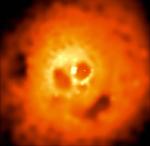 The Perseus Cluster s X Ray Skull
31.10.2000
This haunting image from the orbiting Chandra Observatory reveals the Perseus Cluster of Galaxies in x-rays, photons with a thousand or more times the energy of visible light. Three hundred twenty million light-years distant, the Perseus Cluster contains thousands of galaxies, but none of them are seen here.
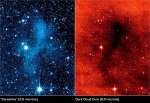 Coreshine from a Dark Cloud
30.09.2010
Stars and their planets are born in cold, dark, interstellar clouds of gas and dust. While exploring the clouds at infrared wavelengths, astronomers have made a surprising discovery -- dozens of cases where dense cloud cores shine by reflecting infrared starlight.
 Atlantis Approaches Mir
2.04.1996
Imagine flying though space and approaching the Mir space station. The crew of the Space Shuttle Atlantis did just this in a mission that ended only two days ago. Mir, now 10 years old, is equipped for scientific experiments in astronomy, physics, materials, biology and chemistry.
|
January February March April May June July August September |
|||||||||||||||||||||||||||||||||||||||||||||||||