
|
You entered: rings
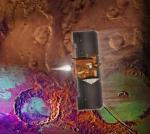 Odyssey at Mars
25.10.2001
After an interplanetary journey lasting 200 days, the Mars Odyssey spacecraft has entered orbit around the Red Planet. This latest success is welcome as in the past, Mars has often seemed a difficult planet to visit.
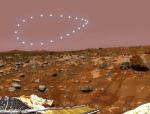 Martian Analemma
26.06.2003
On planet Earth, an analemma is the figure-8 loop you get when you mark the position of the Sun at the same time each day throughout the year. But similarly marking the position...
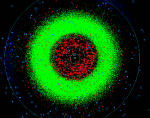 Our Busy Solar System
19.03.2006
Our Solar System is a busy place. Although the major planets get the most press, a swarm of rocks, comets, and asteroids also exist. The above plot shows the placement of known inner Solar System objects on 2002 July 20. The light blue lines indicate the orbits of planets.
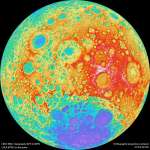 A Colorful Side of the Moon
18.11.2011
This colorful topographical map of the Moon is centered on the lunar farside, the side not seen from planet Earth. That view is available to the Lunar Reconnaissance Orbiter though, as the spacecraft's wide angle camera images almost the entire lunar surface every month.
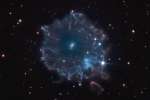 Halo of the Cat s Eye
31.08.2012
The Cat's Eye Nebula (NGC 6543) is one of the best known planetary nebulae in the sky. Its haunting symmetries are seen in the very central region of this tantalizing image, processed to reveal the enormous but extremely faint halo of gaseous material, about 6 light-years across, which surrounds the brighter, familiar planetary nebula.
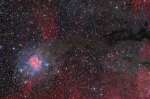 Cocoon Nebula Wide Field
13.09.2012
In this crowded starfield covering over 2 degrees within the high flying constellation Cygnus, the eye is drawn to the Cocoon Nebula. A compact star forming region, the cosmic Cocoon punctuates a long trail of obscuring interstellar dust clouds.
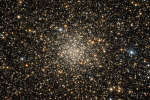 The Reddening of M71
9.12.2014
Now known to be a globular star cluster at the tender age of 10 billion years, M71 is a mere 13,000 light-years away within the narrow boundaries of the faint constellation Sagitta. Close...
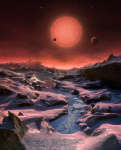 Three Worlds for TRAPPIST 1
7.05.2016
Three new found worlds orbit the ultracool dwarf star TRAPPIST-1, a mere 40 light-years away. Their transits were first detected by the Belgian robotic TRAnsiting Planets and Planetesimals Small Telescope, TRAPPIST, at ESO's La Silla Observatory in Chile. The newly discovered exoplanets are all similar in size to Earth.
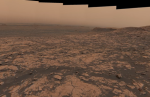 Curiosity Vista from Vera Rubin Ridge
10.09.2018
If you could stand on Mars -- what might you see? If you were NASA's Curiosity rover, just last month you would have seen the view from Vera Rubin Ridge, an intriguing rock-strewn perch on the side of Mount Sharp.
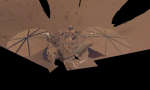 InSight's Final Selfie
4.11.2022
The Mars InSight lander returned its first image from the Red Planet's flat, equatorial Elysium Planitia after a successful touchdown on November 26, 2018. The history making mission to explore the martian Interior using Seismic investigations, geodesy, and heat transport has been operating for over 1,400 martian days or sols.
|
January February March April May June July August September October |
|||||||||||||||||||||||||||||||||||||||||||||||||