
|
You entered: Milky Way
 X-Rays from the Galactic Plane
14.08.2001
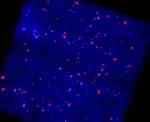
In February 2000, the orbiting Chandra X-ray Observatory spent 27 hours staring into the plane of our Milky Way galaxy. Its target was a spot in the small constellation Scutum, within the Milky Way's zone of avoidance where galactic gas and dust clouds block visible light, making a poor window for optical telescopes.
 Galaxies, Stars, and Dust
13.10.2012
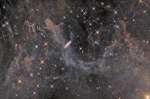
Spiky stars and spooky shapes abound in this deep cosmic skyscape. Its well-composed field of view covers about 2 Full Moons on the sky toward the constellation Pegasus. Of course the brighter stars show diffraction spikes, the commonly seen effect of internal supports in reflecting telescopes, and lie well within our own Milky Way galaxy.
 CMBR Dipole: Speeding Through the Universe
9.03.2008
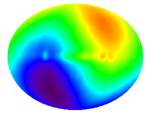
Our Earth is not at rest. The Earth moves around the Sun. The Sun orbits the center of the Milky Way Galaxy. The Milky Way Galaxy orbits in the Local Group of Galaxies. The Local Group falls toward the Virgo Cluster of Galaxies.
 CMBR Dipole: Speeding Through the Universe
6.09.2009
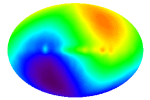
Our Earth is not at rest. The Earth moves around the Sun. The Sun orbits the center of the Milky Way Galaxy. The Milky Way Galaxy orbits in the Local Group of Galaxies. The Local Group falls toward the Virgo Cluster of Galaxies.
 NGC 2419: Intergalactic Wanderer
13.04.2023
Stars of the globular cluster NGC 2419 are packed into this Hubble Space Telescope field of view toward the mostly stealthy constellation Lynx. The two brighter spiky stars near the edge of the frame are within our own galaxy. NGC 2419 itself is remote though, some 300,000 light-years away.
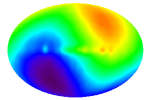 CMB Dipole: Speeding Through the Universe
15.06.2014
Our Earth is not at rest. The Earth moves around the Sun. The Sun orbits the center of the Milky Way Galaxy. The Milky Way Galaxy orbits in the Local Group of Galaxies. The Local Group falls toward the Virgo Cluster of Galaxies.
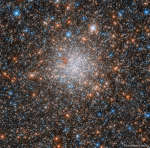 APOD: 2025 December 28 Б NGC 1898: Globular Cluster in the Large Magellanic Cloud
28.12.2025
Jewels don't shine this bright -- only stars do. And almost every spot in this jewel-box of an image from the Hubble Space Telescope is a star. Now, some stars are more red than our Sun, and some more blue -- but all of them are much farther away.
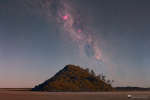 Carina over Lake Ballard
5.01.2018
A jewel of the southern sky, the Great Carina Nebula, also known as NGC 3372, is one of our galaxy's largest star forming regions. Easily visible to the unaided eye it stands high...
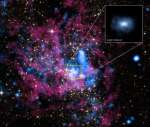 The Quiet Sagittarius A
6.09.2013
Hot gas is hard to swallow. At least that seems to be true for the supermassive black hole at the center of our Milky Way Galaxy. Known as source Sagittarius A*, the Milky Way's black hole is centered in this infrared (red and yellow hues) and X-ray (blue) composite.
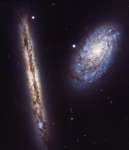 NGC 4302 and NGC 4298
21.04.2017
Seen edge-on, spiral galaxy NGC 4302 (left) lies about 55 million light-years away in the well-groomed constellation Coma Berenices. A member of the large Virgo Galaxy Cluster, it spans some 87,000 light-years, a little smaller than our own Milky Way.
|
January February March April May June July August September October |
|||||||||||||||||||||||||||||||||||||||||||||||||