
|
You entered: cluster gas
 Visitors Galaxy Gallery
27.04.2001
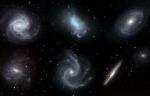
A tantalizing assortment of island universes is assembled here. From top left to bottom right are the lovely but distant galaxies M61, NGC 4449, NGC 4725, NGC 5068, NGC 5247, and NGC 5775/5774. Most are spiral galaxies more or less like our own Milky Way.
 Visitors Galaxy Gallery
18.06.2005
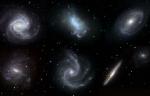
A tantalizing assortment of island universes is assembled here. From top left to bottom right are the lovely but distant galaxies M61, NGC 4449, NGC 4725, NGC 5068, NGC 5247, and NGC 5775/5774. Most are spiral galaxies more or less like our own Milky Way.
 The 37 Cluster
18.11.2005
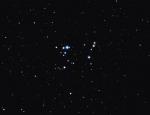
For the mostly harmless denizens of planet Earth, the brighter stars of open cluster NGC 2169 seem to form a cosmic 37. (Did you expect 42?.) Of course, the improbable numerical asterism appears solely by chance and lies at an estimated distance of 3,600 light-years toward the constellation Orion.
 Bright Stars, Dim Galaxy
3.11.2001
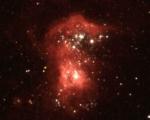
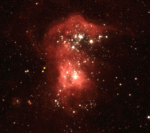
These two clusters of bright, newly formed stars surrounded by a glowing nebula lie 10 million light-years away in the dim, irregular galaxy cataloged as NGC 2366. The Hubble Space Telescope image shows that...
 Bright Stars, Dim Galaxy
14.10.1996
These two clusters of bright, newly formed stars surrounded by a glowing nebula lie 10 million light years away in the dim, irregular galaxy cataloged as NGC 2366. The Hubble Space Telescope image shows...
 The 37 Cluster
14.05.2024
For the mostly harmless denizens of planet Earth, the brighter stars of open cluster NGC 2169 seem to form a cosmic 37. Did you expect 42? From our perspective, the improbable numerical asterism appears solely by chance. It lies at an estimated distance of 3,300 light-years toward the constellation Orion.
 A Cygnus Star Field
28.07.2004
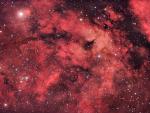
In the constellation of the swan near the nebula of the pelican lies the gas cloud of the butterfly surrounding a star known as the hen. That star, given the proper name Sadr, is visible to the unaided eye but found here as the brightest object on the upper left.
 Young Suns of NGC 7129
16.10.2025
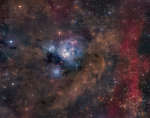
Young suns still lie within dusty NGC 7129, some 3,000 light-years away toward the royal constellation Cepheus. While these stars are at a relatively tender age, only a few million years old, it is likely that our own Sun formed in a similar stellar nursery around five billion years ago.
 M16 Close Up
9.09.2021
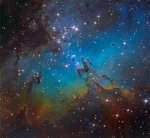
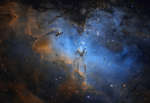
A star cluster around 2 million years young surrounded by natal clouds of dust and glowing gas, M16 is also known as The Eagle Nebula. This beautifully detailed image of the region adopts the colorful Hubble palette and includes cosmic sculptures made famous in Hubble Space Telescope close-ups of the starforming complex.
 M16 and the Eagle Nebula
15.10.2015
A star cluster around 2 million years young surrounded by natal clouds of dust and glowing gas, M16 is also known as The Eagle Nebula. This beautifully detailed image of the region includes cosmic sculptures made famous in Hubble Space Telescope close-ups of the starforming complex.
|
January February March April May June July August |
||||||||||||||||||||||||||||||||||||||||||||||||||||||||