
|
You entered: crater
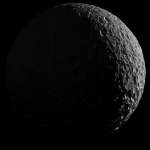 Mimas in Saturnlight
30.07.2021
Peering from the shadows, the Saturn-facing hemisphere of Mimas lies in near darkness alongside a dramatic sunlit crescent. The mosaic was captured near the Cassini spacecraft's final close approach on January 30, 2017. Cassini's camera was pointed in a nearly sunward direction only 45,000 kilometers from Mimas.
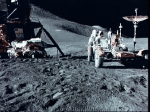 Apollo 15: Driving on the Moon
7.06.1997
Apollo 15 astronaut James Irwin works on the first Lunar Roving Vehicle, before he and fellow astronaut David Scott take it out for a drive. Sloping up behind the lunar module "Falcon" on the left are lunar mountains Hadley Delta and Apennine Front, while about 5 kilometers behind Irwin is St. George Crater.
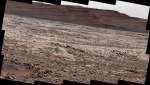 The Gator Back Rocks of Mars
15.04.2022
Wind-sharpened rocks known as ventifacts, cover this broad sloping plain in the foot hills of Mount Sharp, Gale crater, Mars. Dubbed gator-back rocks their rugged, scaly appearance is captured in these digitally stitched Mastcam frames from the Curiosity rover on mission sol 3,415 (March 15, 2022).
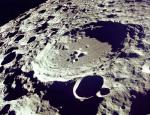 Lunar Farside from Apollo 11
12.03.2003
The far side of the Moon is rough and filled with craters. By comparison, the near side of the Moon, the side we always see, is relatively smooth. Since the Moon is rotation locked to always point the same side toward Earth, humanity has only glimpsed the lunar farside recently -- last century.
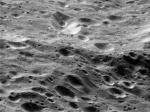 620 Kilometers Above Rhea
13.12.2005
What does the surface of Saturn's moon Rhea look like? To help find out, the robot Cassini spacecraft currently orbiting Saturn was directed to fly right past the second largest moon of the gas giant planet late last month.
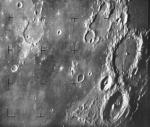 Moon Crashers
15.10.1999
On July 31, 1964, Ranger 7 crashed into the Moon. Seventeen minutes before impact it snapped this picture - the first image of the Moon ever taken by a U.S. spacecraft. Of course Ranger 7 was intended to crash, transmitting close-up pictures of the lunar surface during its final moments.
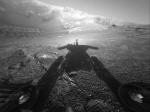 Shadow of a Martian Robot
4.02.2007
What if you saw your shadow on Mars and it wasn't human? Then you might be the Opportunity rover currently exploring Mars. Opportunity and sister robot Spirit have been probing the red planet since early 2004, finding evidence of ancient water, and sending breathtaking images across the inner Solar System.
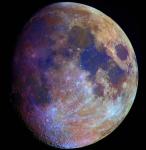 The Color of the Moon
16.02.2006
Earth's Moon is normally seen in subtle shades of grey or yellow. But small color differences have been greatly exaggerated to make this dramatic mosaic image of the Moon's gibbous phase. The familiar Sea of Tranquility (Mare Tranquillitatis) is the blue area right of center.
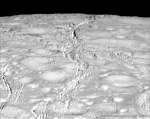 The Fractured North Pole of Saturns Enceladus
21.10.2015
The north pole of Saturn's moon Enceladus is unexpectedly fascinating and complex. Previous to the latest flyby of the robotic Cassini spacecraft, the northern region was known mostly for its unusually high abundance of craters.
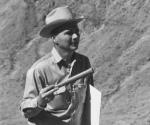 Eugene Shoemaker: 1928-1997
15.01.1998
Eugene Shoemaker's passion was Astrogeology. He dreamed of going to the Moon. Credited with inventing the branch of Astrogeology within the U.S. Geological Survey, his contributions to the field and the study of impact craters, lunar science, asteroids, and comets are legendary.
|
January February March April May June July August September October |
|||||||||||||||||||||||||||||||||||||||||||||||||