
|
You entered: galaxy cluster
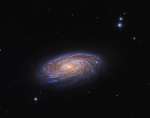 Messier 88
30.01.2010
Charles Messier described the 88th entry in his 18th century catalog of Nebulae and Star Clusters as a spiral nebula without stars. Of course the gorgeous M88 is now understood to be a galaxy full of stars, gas, and dust, not unlike our own Milky Way.
 Distortion from a Distant Cluster
23.08.2001
This stunning color deep sky view toward the constellation Pisces was made with data from a fast, sensitive, digital detector known as the Big Throughput Camera operating at Cerro Tololo Inter-American Observatory in Chile.
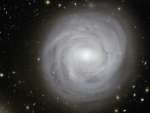 Anemic Galaxy NGC 4921 at the Edge
9.02.2009
How far away is spiral galaxy NGC 4921? Although presently estimated to be about 320 million light years distant, a more precise determination could be coupled with its known recession speed to help humanity better calibrate the expansion rate of the entire visible universe.
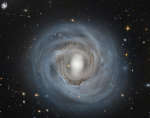 Anemic Spiral NGC 4921 from Hubble
25.11.2013
How far away is spiral galaxy NGC 4921? Although presently estimated to be about 310 million light years distant, a more precise determination could be coupled with its known recession speed to help humanity better calibrate the expansion rate of the entire visible universe.
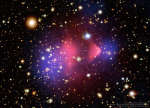 Sonified: The Matter of the Bullet Cluster
16.12.2020
What's the matter with the Bullet Cluster? This massive cluster of galaxies (1E 0657-558) creates gravitational lens distortions of background galaxies in a way that has been interpreted as strong evidence for the leading theory: that dark matter exists within.
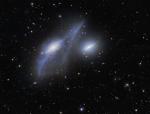 Markarian s Eyes
8.06.2007
Across the heart of the Virgo Galaxy Cluster lies a string of galaxies known as Markarian's Chain. Prominent in Markarian's Chain are these two interacting galaxies, NGC 4438 (left) and NGC 4435 - also known as The Eyes.
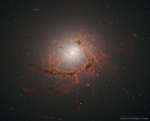 NGC 4696: Filaments around a Black Hole
7.12.2016
What's happening at the center of elliptical galaxy NGC 4696? There, long tendrils of gas and dust have been imaged in great detail as shown by this recently released image from the Hubble Space Telescope.
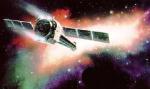 Name This Satellite
20.04.1998
Can you name this satellite? In December, NASA's third Great Observatory is planned for launch. The two NASA Great Observatories currently in orbit are the Hubble Space Telescope and the Compton Gamma-Ray Observatory, both now named for famous scientists. But after whom should the Advanced X-ray Astrophysics Facility (AXAF) be named?
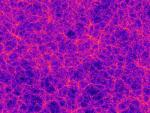 The Universe in Hot Gas
20.08.2002
Where is most of the normal matter in the Universe? Recent observations from the Chandra X-ray Observatory confirm that it is in hot gas filaments strewn throughout the universe. "Normal matter" refers to known elements and familiar fundamental particles.
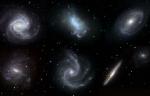 Visitors Galaxy Gallery
18.06.2005
A tantalizing assortment of island universes is assembled here. From top left to bottom right are the lovely but distant galaxies M61, NGC 4449, NGC 4725, NGC 5068, NGC 5247, and NGC 5775/5774. Most are spiral galaxies more or less like our own Milky Way.
|
January February March April May June July August September October |
|||||||||||||||||||||||||||||||||||||||||||||||||